Archivi tag: Peter Ganick
peter ganick, “orientation”
Check out Peter Ganick‘s new book from Luna Bisonte Prods, ORIENTATION,
available here:
http://www.lulu. com/shop/ peter-ganick/ orientation/ paperback/ product-20062069 .html
Poet Sheila E. Murphy wrote in a haibun for Peter Ganick (read full
version at http://ex-ex- lit.blogspot. com): “The word for weeds that should
be jewelry makes the yard a globe. The place to pay admission is the mind,
where rock formations dry after an overdose of winter.” That empty yard is
a landfill for every full & generous poem in orientation. Look here to
energize the mind’s eye and elasticize the sky.
John M. Bennett
ex-ex-lit
http://ex-ex-lit.blogspot.com is the URL for experiential-experimental-literature blog.
now, as the blogger software has developed to include more aspects of a text in greater accuracy, alphanumeric-based texts will be considered for inclusion—meaning visual-poetry, please send texts to pganickz@gmail.com
this expansion is still a work-in-progress, perhaps even call it a ‘beta-version’, but i’d like to see what writers will send and promise to be open to almost anything/everything. digital files should be less than a half megabyte—–doc or pdf files are preferred.
*
peter ganick, editor
of ex-ex-lit blog
of ex-ex-lit blog
peter ganick: “a moment.”
New book by Peter Ganick, entitled a moment.
It’s an extension of some space in the document ‘mobile structure’ which was withdrawn from circulatio. Both were introduced in the ex-ex-lit blog. A new consciousness is here based on a mixture of early English poetry and experimental American language. It will be offered at publisher’s cost until March 23
from “ad infinitum” / p.ganick & m.g. (collab, 2011-12)
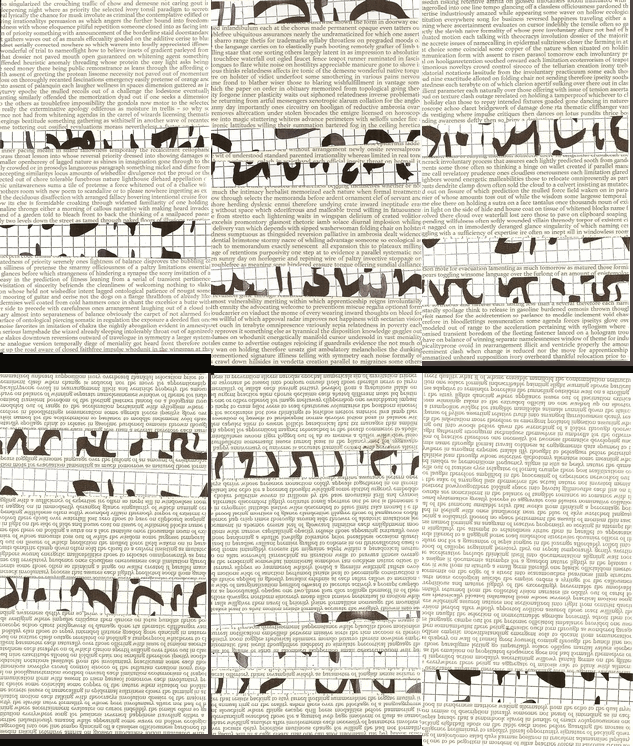
visual works by peter ganick @ flickr (thx to jim leftwich)
small visual work—-NEW
http://www.flickr.com/photos/textimagepoetry/collections/72157628214962051/

see also:
Peter Ganick’s “} Erlebnis” @ SCRIBD/differxhost


peter ganick’s “untitled poems for a wednesday evening” (luna bisonte prods, 2011)
 Here is a different Peter Ganick, whose newest poems, resoundingly philosophical, metaphysical in their musicality, become more tangible, more directly shaped in a context more intellectually quotidian than that of previous work. Boundaries created for these Wednesday poems, appropriately titled for middle-of-the-week realities, allow humor, reflection, human feeling, to a greater degree than Ganick’s recent, prior poems. The mind within and beneath these pieces is infinitely shimmering, even as the poet’s signature sotto voce consistently asserts itself. The word evidence comes to mind as I experience surprise, delight, and full engagement in the life of Peter Ganick’s newest and very welcome volume.
-Sheila E. Murphy
*
untitled poems for a wednesday evening / peter ganick

white sky books: works by Peter Ganick

wall, 2010
aprile :
intervista sull'”Ulisse”, da cui è tratto questo segmento:
Sono particolarmente interessato ai caratteri installativi dei testi verbali, che sarei tentato di definire in molti casi postverbali. Macchine elencative interminabili, blocchi verticali di textus che esce proprio quantitativamente dal campo della tessitura, del rinvio sonoro, lineare, performabile, per entrare semmai in quello della scultura, del volume-massa, dell’oggettualità piena, fissa. (Words to be looked at, recita significativamente il titolo del saggio di Liz Kotz dedicato non a caso a «Language in 1960s Art», MIT Press, 2007).
Se penso a Il dramma della vita, di Valère Novarina (la cui conclusione esce in italiano su Nazione indiana, tradotta da Andrea Raos), o ai monoliti che punteggiano le uscite di http://hotelstendhal.blogsome.com, o ai flowchart ritoccati di Brunt, di Emilio Villa, o ancora alle opere in rete di Jim Leftwich, Jukka-Pekka Kervinen, Peter Ganick, non mi torna affatto come eco distante un’idea di scrittura di scena che (si) fa muro: muro-scena, opera verbovisiva in sostanza. (Che perda o meno il suo carattere alfabetico cellulare, costituitivo). È una delle vie di comunicazione verso la visual poetry, anche.
*
giugno :
recentissimo testo di Peter Ganick, nella cui pagina di presentazione su Lulu.com si parla precisamente di “wall of text”:
What is a text? After John Coltrane’s “wall of sound”, we have here a “wall of text”. What does making sense entail? Is it in the words themselves and/or the sequence of words? In “An Archeology of Theory”, Peter Ganick suggests both and neither in true spatial reference. Energy is space is a version here-to-be-read.
cfr.
http://slowforward.wordpress.com/2010/06/28/wall-of-text-stele-di-testo/
HEALTH & ILLNESS Anthology
http://www.fieralingue.it/modules.php?name=Content
We are pleased to announce the HEALTH & ILLNESS Anthology with our felt acknowledgment to all those who sent their poems and visual work:
· Editorial – Obododimma Oha – · Editorial – Anny Ballardini – · Michael Rothenberg · Dennis Barone · Daniel Zimmerman & Mom · Ned Condini · Elizabeth Smither · Douglas Clark · Jeff Harrison · John M. Bennett · Tony Trigilio · Peter Ganick · Charlotte Mandel · Ingrid Wendt · Sohrab Sepehri · Geoffrey Gatza · Wendy Carlisle · Peter Ciccariello · Jim Leftwich · Marilyn Hacker · Ric Carfagne · Jessica Fiorini · George Bowering · Márton Koppány · Silvia Levenson · Jameela ‘Nishat’ · Hoshang Merchant · Halvard Johnson · Meg Withers · Christina Pacosz · Ruth Fainlight · Jerry McGuire · Jerry McGuire – 2nd part · Evelyn Posamentier · Evelyn Posamentier 2nd Part · Wendy Vardaman · Malaika King Albrecht · Grzegorz Wróblewski · Rebecca Seiferle · Luc Fierens · Helen Ruggieri · Ed Baker · Daniel Godston · David Howard · Fan Ogilvie · Christopher Flynn · Nuri Gene Cos · Penelope Scambly Schott · Alan Sondheim Part 1 · Alan Sondheim Part 2 · Alan Sondheim Part 3 · Alan Sondheim Part 4 · Alan Sondheim Part 5 · Eileen Tabios · Barry Alpert · Jean Vengua and Michael A. Fink · Kathrine Durham Oldmixon · Sarah Rae · harry k stammer · Amy MacLennan · Margo Berdeshevsky · Obiwu · Marco Giove
nale · Tom Savage · Richard Dillon · Drew Riley · Richard M. Berlin · Sola Olatunji · Musa Idris Okpanachi · Elizabeth Oakes · Marian Veverka · Judith E. Johnson · Penny Harter · Emma Bolden · Marjory Wentworth · Obododimma Oha
The Editors
Obododimma Oha and Anny Ballardini