Archivi categoria: experimental poetry
TRNSFR mag

Testi installativi
Ci si trova sempre a dovere ma in fondo anche a volere (ri)definire e (ri)dire cosa si può intendere per testo installativo.
Un testo che non chieda necessariamente una lettura lineare. Un testo in cui l’impatto visivo configura già un oggetto estetico verso cui il lettore può dirigere uno sguardo non necessariamente analitico, geometrizzante, decrittante. Un testo che può indurre analisi e esplorazione minuta e che tuttavia persuade anche prima che questa si compia. Eccetera.
Più delle parole valgono gli esempi. Varie volte ho fatto quello de Il dramma della vita, di Valère Novarina, tradotto da Andrea Raos e uscito prima in Nazione indiana e poi in gammm. Qui il testo perfettamente leggibile eccede — per accumulo e ossessione elencativa felicissima quanto spiazzante e sfiancante — le possibilità e qualsiasi buona volontà di un classico ‘lettore lineare’, di ogni lettura sequenziale.
Un altro esempio potrebbe essere l’anonimo Abacuz pubblicato in marzo su http://hotelstendhal.blogsome.com: clic su http://www.box.net/shared/ohduc7zh3q. Ovviamente il dato installativo-visivo è totalizzante, in questo caso. E, prima ancora, spicca in primo piano (escludendo altri piani) il fatto che il meccanismo in gioco sia puramente ottico, ininterpretabile: accumulo da vedere, installazione senza alternative. O meglio: installazione dell’idea stessa di installazione.
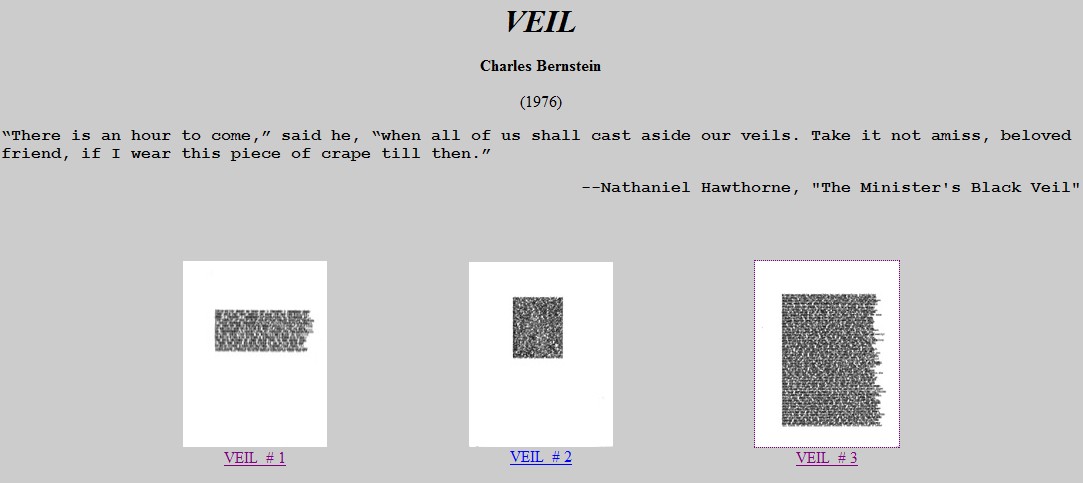
Infine, si può pensare al “solid language” di Veil, di Charles Bernstein, uscito nel 1976 e leggibile online qui: http://epc.buffalo.edu/authors/bernstein/books/veil/index.html (nonché acquistabile come libro o scaricabile liberamente come pdf c/o Xexoxial Editions a questo indirizzo: http://xexoxial.org/is/veil/by/charles_bernstein)
*
*
Promemoria: OGGI: Locandine d’artista + Stéphane Bouquet + Florinda Fusco
OGGI, venerdì 26 giugno, dalle ore 20:30
presso il centro culturale La camera verde
(Roma, via G. Miani 20)
Locandine d’artista
immagini e/o testi di
Francesco Forlani, Andrea Inglese, Florinda Fusco, Michele Zaffarano, Renata Morresi, Marco Giovenale, Jennifer Scappettone, Alfredo Anzellini,
Zeno Tentella, Antonio Semerano, Giuliana Laportella, Giuliano Mesa, Manuela Sica, Giacomo Leopardi, Pierre Martin
inoltre:
presentazione del libro
Dizionario di quest’uomo – Dictionnaire de cet homme
di Stéphane Bouquet
(La camera verde, collana Calliope)
introduzione e traduzione italiana di Andrea Inglese
e:
segnalazione dell’uscita (+ breve lettura) del nuovo libro di
Florinda Fusco, Tre opere
(Oèdipus, 2009, collana “i megamicri”)
* * *
* * *
La camera verde è in Via Giovanni Miani 20 – 00154 Roma
(quartiere Ostiense)
tel. 340-5263877
e-mail: lacameraverde [at] tiscali [dot] it
pagina (provvisoria): http://www.lacameraverde.com/
News from T.A.P.: Andrew Lundwall

Matina L. Stamatakis : Grapyrus
– – – – – – – – – – – – – – –
X E R O L A G E 4 3
– – – – – – – – – – – – – – –
Xerolage 43—Matina L. Stamatakis
Grapyrus
Matina Stamatakis has “arrived” even if the rest of the world has been too slow to realize it. Her newest “art/non” textscape is a veritable plum pudding of ruthless extravagance, a cryptological scherzo written in “sanscript”, so to speak. Teasing out texture from text, this most recent offering from the Xerolage series has a haunting aspect that unites papyri and the phantom after-effects of words in constant stochastic exile. In essence, Stamatakis “writes” perpetually double, the reflection upon a surface of “lin/geist” that judders with an ekphrastic motion of the cinematic or photographic double-take.
—Kane X. Faucher
Tombstones and footprints, prehistoric imperial Chinese silk distressed and preserved in airtight tombs, Sapphic papyrus scrolls used as winding sheets for the human dead: languaged shapes (letters, glyphs, cuneiform, runes) layer each other on multidimensional, neonic, poly-textural surfaces that glow through the eras, aeons and ages. Evocative of sound, syntax and melismatic intution, these works are endlessly resonant through time, space, and mind, expanding them all.
—Maria Damon
In Matina Stamatakis’ Grapyrus, an utterly fresh light unveils antiquities. Under the cold glare of the photocopier’s bulb new thoughts are seared onto the richly textured venerability of the page. Here is a vibrantly dark art that does not merely mimic or ape antediluvian roots, but consciously honors and revises them, relentlessly refreshing deep-seeded threads of thought. Flourishing gestures of contemporary graffiti no longer deface or elide, but honor; the visually brutalizing process of Xeroxing accentuates, antiques. Xerolage 43-Matina StamatakisHere papyrus and spray paint conspire to create a Rosetta stone for the hermetic communiqués scribbled on bathroom walls. The “reader” wanders through a nonexistent city, inexplicably entranced by the tattered posters pasted to crumbling edifices, and couldn’t be happier to be so utterly lost.
—John Moore Williams
more at:
http://xexoxial.org/is/xerolage43/by/matina-l-stamatakis
The primary investigation of Xerolage is how collage technique of 20th century art, typography, computer graphics, visual & concrete poetry movements & the art of the copier have been combined. Each issue is devoted to the work of one artist.
24 pages, 8.5 x 11, $6 includes postage
Subscriptions: 4 issues/$20
XEXOXIAL EDITIONS
10375 Cty Hway Alphabet
La Farge WI 54639
The reading at Th!nk Art: Graffi, Attanasio, Giovenale, Frene, hosted by Scappettone
this is the Italian Poetry reading and conversation at Chicago’s Th!nkArt Salon, broadcast on Chicago Public Radio
http://www.chicagopublicradio.org/Content.aspx?audioID=34790
(Press “pop-out” and then the “play” button)
*
Friday, May 29, 7:30pm
Bilingual reading and discussion/salon featuring Maria Attanasio, Giovanna Frene, Marco Giovenale & Milli Graffi
Moderators: Jennifer Scappettone, Francesco Levato (Poetry Center) & Chris Glomski (UIC)
1530 N. Paulina, Suite F.
Chicago, IL
+
!! Thanks to Litmus Press !!

gammm : 1 gennaio – 21 giugno 2009 : index
– pierre alferi. da cercare una frase. 1991 [22-02-2009 .it]
– alfredo anzellini. ebook: ouverture. 2009 [04-04-2009]
– syd barrett. word song. 1969 [10-05-2009 .en]
– ida börjel. ebook: europeiska midjemått / european waistlines / girovita europei [12-01-2009 .sv / .en / .it]
– ida börjel. da europeiska midjemått. 2001. I [12-01-2009 .sv / .en / .it]
– ida börjel. da europeiska midjemått. 2001. II [16-04-2009 .sv / .en / .it]
– ida börjel. da europeiska midjemått. 2001. III [8-05-2009 .sv / .en / .it]
– stéphane bouquet. da le mot frère. 2005 [22-01-2009 .fr / .it]
– claude closky. eight works from www.sittes.net. 1999-2006 [17-05-2009 .fr / .en]
– ugo coppari. da limbo mobile. 2009. I [22-03-2009 .it]
– ugo coppari. da limbo mobile. 2009. II [07-06-2009 .it]
– aleister crowley. liber al vel legis. capitolo I. 1904 [21-05-2009 .en /.it]
– alessandro de francesco. ebook: da 1000 m. 2009 [05-03-2009 .it / .en / .fr]
– marcel duchamp. il processo creativo. 1957 [24-02-2009 .fr / .it]
– denise duhamel. da kinky. 1997. I [12-03-2009 .it]
– max frisch. da diario della coscienza. 1974. VI [19-01-2009 .it]
– max frisch. da diario della coscienza. 1974. VII [9-03-2009 .it]
– giulio ossequente. da prodigi. IV-V sec. d.C. [29-03-2009 latino e italiano]
– kenneth goldsmith. paragrafi sulla scrittura concettuale. 2005 [23-04-2009 .en / .it]
– emilio isgrò. ebook: l’avventurosa vita di emilio isgrò… 1975 [26-01-2009 .it]
– joseph kosuth. art as idea as idea. 1966 [03-05-2009 .en]
– drew kunz. light / shadow / wall. 2008 [16-02-2009]
– jim leftwich. new year’s caution totem. 2008 [01-01-2009]
– giancarlo majorino. da viaggio nella presenza del tempo. 2008. III [29-01-2009 .it]
– bruno munari. emozioni. 1995 [09-04-2009 .it]
– claude royet-journoud. del vicinato e della forma. 2007 [24-05-2009 .fr / .it]
– zachary schomburg. da the man suit. 2007. I [05-01-2009 .en / .it]
– zachary schomburg. da the man suit. 2007. II [02-02-2009 .en / .it]
– zachary schomburg. da the man suit. 2007. III [26-02-2009 .en / .it]
– vincent tholomé. une station service. 2006 [14-06-2009 .fr / .it]
– cecil touchon. ebook: the raven (for edgar allan poe). 2008 [08-02-2009]
– ben vautier. bizart baz’art. 2003 [02-03-2009]
– lawrence wiener. response to three statements by david lamelas. 1970 [28-05-2009 .en / .it]
– william xerra. io mento. 2002 [04-06-2009 .it / .en]
:
…and more:
sol lewitt [15-01-2009], their hands [08-03-2009], imbutofono track 2 [15-03-2009], april 2009: the 11 chaps [12-04-2009], fiona banner [30-05-2009], dash snow: 18 polaroids from tinyvices.com [14-05-2009], robert smithson [11-06-2009], sam durant [18-06-2009], burney akab aion [21-06-2009]
TODAY: book release party


TODAY: Saturday June 20, at 8pm
Book Release Party!
Celebrating From Dame Quickly by Jennifer Scappettone
and
Hyperglossia by Stacy Szymaszek
Short readings, wine and food will be provided
543 Union St.
Brooklyn, NY
718.243.1572
Free & open to the public
http://litmuspress.org
Sztuka Fabryka
> sztuka fabryka … is a worldwide artists organisation / conceived conceptually by geert de decker (spokesman) / with technical and creative support of: bert rocket (usa) – stanislaw dragowanowitz (ussr) & sir walter crunckett the 3rd of paddington high (scotland) /
> sztuka fabryka is worldwide active since 1986 / as artist – art events organiser & curator – researcher in art – archivist – … /
> sf artworks are available / at www.100artworks.com
> sf print – non omnis moriar – / at www.littleartbook.com /
la “poesia dell’anima”
 “Tutte le religioni dei ‘popoli del Libro’, Ebrei, Cristiani e Mussulmani… sono basate sull’assunto che all’inizio sta il Verbo”, sottolinea Gysin. “Tutto quello che è scaturito da un simile inizio sembra funzionare piuttosto male… [Il nostro] metodo consisteva innanzitutto nel frantumare la sequenza temporale… frantumazione prodotta dal cut-up. C’era l’intenzione di farla finita con il Verbo stesso, non soltanto di frantumare l’ordine sequenziale; trovare un’altra strada. Ci sono altri modi di comunicazione, tentare di trovarli deve iniziare eliminando il Verbo. Se tutto è cominciato con il Verbo, se ci fa schifo quello che ne è uscito, e lo fa, andiamo alla radice della cosa, mutiamola radicalmente”.
[…]
Immediatamente dopo che gli fu illustrata, Burroughs adottò con enorme entusiasmo la tecnica del cut-up, mettendola al lavoro sul mostruoso manoscritto da cui aveva già tratto Il pasto nudo.
[…]
“William si serviva del suo materiale altamente volatile, dei suoi testi inimitabili che sottoponeva a tagli implacabili. Era sempre il più deciso della compagnia. Nulla riusciva a turbarlo…” (Here To Go, p. 185) Gregory Corso, invece, rimase più che turbato. Corso collaborava a Minutes To Go, il primo libro di cut-up. assieme a Gysin, Burroughs e Sinclair Beiles, ma per la pagina conclusiva contribuì con un poscritto che rendeva palese come fosse totalmente sconcertato che gli si potesse chiedere di tagliare la sua “vera voce” — come se non fosse affatto “un testo sacro”, disse Ginsberg. (Beat Book, pp. 77-78).
“…la poesia che scrivo viene dall’anima e non dal dizionario” protestava Corso. “La poesia di parola è per tutti, ma la poesia dell’anima non è altrettanto distribuita…, la mia poesia è cut-up naturale, non ha bisogno di forbici per essere creata… ”
[…]
Ginsberg riconobbe “l’importante risultato tecnico” ottenuto con i cut-up ma confessò anche: “Avevo reagito con resistenze e irritazione… perché minacciava tutto ciò su cui baso la mia esistenza… con la perdita della Speranza e dell’Amore; potrei forse anche sopportarne la perdita, se solo mi si lasciasse la Poesia, per continuare a essere quello che sempre volevo, venerato misero poeta”
[ Terry Wilson, Brion Gysin, una biografia rivalutazione; in: W.S.Burroughs, B.Gysin / Il demone della letteratura, ShaKe, Milano 2008; pp. 161 e 163 ]
*
*
n.b.: nessuna differenza tra le opposizioni di Corso e Ginsberg e quelle della Tradizione Italiana a qualsiasi scrittura di ricerca.
PROTRACTED TYPE, by Nico Vassilakis
PROTRACTED TYPE, by Nico Vassilakis, is a collection of visual poetry.
it’s b&w VisPo peppered with text . about 270 pages.
reviewers or the financially demur or the merely curious can find a free download.
http://www.lulu.com/content/paperback-book/protracted-type/6845937

blurbs?
In Protracted Type, Nico Vassilakis provides us with a stunning and extensive survey of the impressive variety of his visual and conceptual work with language over the past several years. The book is punctuated with thoughtful statements about the nature of creating that work, of “finding your aleatoric self among the pencils”; i.e., coming to grips with the paradox of working subconsciously with language which is generally experienced as a conscious medium. In one of his statements he describes his creative process as a kind of disassociation: “I let my brain do the thinking. I watch it think for me…it makes the associations…maybe my brain thinks I’m staring and is piecing the puzzle together for me.” This is an excellent description of the creative process at its best.
Vassilakis has explored the possibilities of visual poetry from the outer limits of the purely letteral to the purely graphic, and the results are consistently stimulating and resonant: from enlarged and manipulated photos of typewriter keys and printed letters, to collaged cut-ups, to glyphic drawings, to concrete poetry, to photocopier artifacts, Vassilakis has given us a tour-de-force of styles and approaches. This is an essential work, and would be a bargain at three times the price.
John M. Bennett
*
the formula states, “a picture equals a thousand words.” what, then, is the formula when the image is itself language? and, that the language ranges from its initial formation slowly congealing afloat in the willful stage of conscious intent to its full and robust compositional form as a typographic-scape on a page?
to approach this collection, think first of a landscape artist’s precise use of topographic perspective at the marco level and the same artist as a still life painter at the micro level rendering the sensual curve of an apple in a tree within the macro-scape. then, transfer your trained eye and esthetic process onto and into vassilakis’ typographic-scapes and typographic-stills to wander with delight and wonder within one of the most comprehensive, serious and playful overviews and inner views of type and font with accents by hand to date.
Karl Kempton
*
A tour de force through visual poetry, Protracted Type is a place where, according to the author, “letters are vulnerable and cant always stand on their own.” Within, our thoughts become interlaced with Vassilakis’s perception of visual poetry from minimal to maximal with letters ranging from typewriter and digital through handwritten, shorthand, and altered text, text sometimes so overlayed as to become asemic. This is a thoroughly enjoyable and beautiful book.
*
Kathy Ernst
It’s drizzling on Admiral Way. Cigarette smoke trailing through his black hair, the Captain stands stock-still at the window, his sea legs steady, framed by the world he’s framing. He sees this series of black and white visual poems–and these poems are seen, composed, more than they are written–particulates, letters, phrases, fields of words before and after they construct their meaning, some sharp, some fuzzy, some slipping over the edge. At the center point of the glass, where inside and outside are indivisible, these poems fuse, the Captain’s eyes seizing–seized by–the world he perceives. At the very instant of our dissembling, he nods, our language comes together.
Crag Hill