Archivi tag:  Paul Klee

Asemic writing, asemantic writing, desemantized writing

Luigi Di Cicco (see https://slowforward.net/2025/01/18/scritture-sul-ciglio-del-significato-luigi-di-cicco-2024-parte-prima/ reminds us that the term “scrittura asemantica” was coined by the Italian critic Gillo Dorfles in 1959 and it had (in the critic’s mind) the same meaning of the late 90s term “asemic”, coined by John Byrum and Jim Leftwich and spread by many artists, especially by Tim Gaze and Michael Jacobson.
In his study Dorfles was dealing with the art of Giuseppe Capogrossi (https://slowforward.net/2025/03/14/dorfles-capogrossi-1959/).
Dorfles used the term again in the following decades, for example in Le scritture asemantiche di Irma Blank, an essay he wrote for a 1974 art exhibit of Irma Blank. I published that text here: https://gammm.org/2007/07/18/blank-dorfles/ [English translation included].
In the same year(s), the artist Tomaso Binga (alias Bianca Menna) was working on her “scritture desemantizzate”: https://www.rivistasegno.eu/le-scritture-desemantizzate-di-tomaso-binga/.

My long essay (in Italian) about asemic writing is here: https://www.ikona.net/marco-giovenale-asemics-senso-senza-significato/ and it’s maybe still useful in exploring non-semantic / illegible / linguistically glitched forms of art, for example Arturo Martini’s book Contemplazione (1918), Henri Michaux’ Alphabet (1927), Paul Klee’s “Abstrakte Schrift” (1931), Isidore Isou’s “hypergraphies” (40s), Bruno Munari’s Scritture illeggibili di popoli sconosciuti (“Illegible Writings of Unknown Peoples”: after 1945), Christian Dotremont’s texts (1950), Brion Gysin’s Marrakesh (1955) and several other works by him; or 65 Maximiliana ou l’exercice illégal de l’astronomie by Max Ernst (1964) etc.

(Up to Luigi Serafini‘s masterpiece, Codex Seraphinianus, 1976-78, published by Franco Maria Ricci in 1981: https://www.francomariaricci.com/it/libri/codex-seraphinianus).

*

Addenda

Miekal And:
«F.W.H. Myers — a classicist who also coined “telepathy” — in 1885, in Automatic Writing II, in the “Proceedings of the Society for Psychical Research” used “asemia” and “asemic” in a medical sense, denoting a “defect in the power of giving signs,” and described a person producing illegible automatic writing as having “asemic troubles”. He even produced the stuff himself: in 1875 he scrawled rapidly many meaningless interlacing strokes that sometimes vaguely resembled letters but never formed a legible word — and considered these creations of no interest».

Actually, the doubts some people had in using the term “asemic”, at the beginning of our century, was due precisely to the medical meaning of the word. It seems to me that some dictionaries updated their lists & mentioned the other meaning, the ‘artistic’ one, only in 2017.

You can find Myer’s text here: https://archive.org/details/proceedingsofsoc03soci

*

more links:

https://slowforward.net/2025/03/07/ricominciamenti-luigi-di-cicco-2025/
https://slowforward.net/2025/01/18/enzo-patti-un-contributo-su-asemia-da-un-saggio-di-gillo-dorfles-unannotazione-di-luigi-di-cicco/
https://slowforward.net/2024/12/31/luigi-di-cicco-capogrossi-dorfles-scrittura-asemantica/
https://alfabetadue.it/2015/02/15/gioco-e-radar-05-asemic-writing/
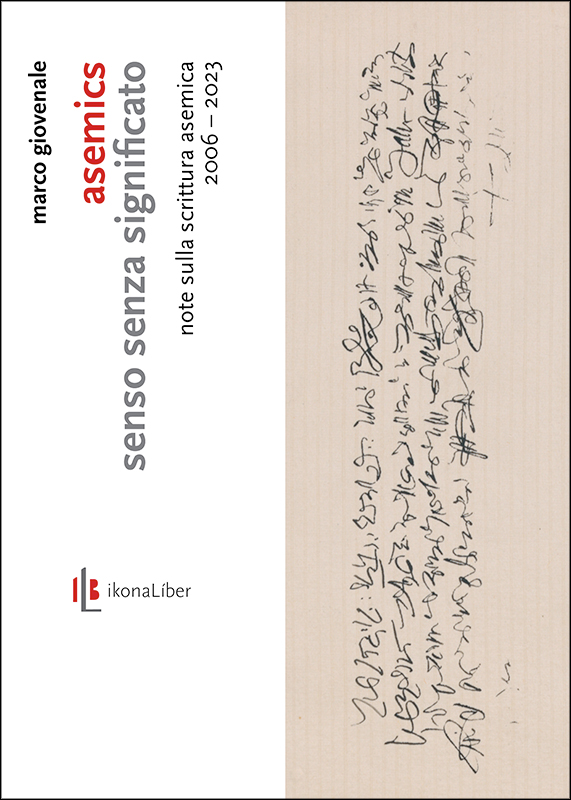
 

oggi, 3 marzo, a roma, allo studio campo boario: “asemics. senso senza significato”, di mg. presentazione di giuseppe garrera

OGGI, venerdì 3 marzo, alle ore 18:00

a Roma, presso lo Studio Campo Boario (Viale del Campo Boario 4a)

Giuseppe Garrera presenta

ASEMICS. Senso senza significato

di Marco Giovenale

(IkonaLíber, 2023)

http://www.ikona.net/marco-giovenale-asemics-senso-senza-significato

Questa sequenza di annotazioni, fuori da ogni ipotesi di esaustione, propone un possibile itinerario attraverso la storia delle espressioni “scrittura asemica” (o “asemantica” o “desemantizzata”) e “asemic writing”; e inoltre offre alcuni elementi di teoria che configurano l’identità di questa pratica artistica come «macchina di disorganizzazione e disintegrazione del significato ad opera del senso stesso».

Libro con immagini di:
Rosaire Appel, Anneke Baeten, May Bery, Marcia Brauer, Axel Calatayud, Cecelia Chapman, Tim Gaze, Ariel González Losada, Michael Jacobson, Satu Kaikkonen, Paul Klee, Karri Kokko, Jim Leftwich, Arturo Martini, John McConnochie, Miriam Midley, Stephen Nelson, Laura Ortiz, Ekaterina Samigulina / Tae Ateh, Lucinda Sherlock, Jay Snodgrass, Lina Stern, Miron Tee, Cecil Touchon

Evento facebook:
https://www.facebook.com/events/731660138335394

Ulteriori informazioni:
http://www.ikona.net/marco-giovenale-asemics-senso-senza-significato/

https://slowforward.net/2023/02/20/asemics-senso-senza-significato-ikonaliber-cenni-di-storia-e-teoria-dellasemic-writing/

Anteprima:
https://issuu.com/ikonaliber/docs/asemics_anteprima

Pagina facebook:
https://www.facebook.com/giovenale.asemics.ikonaliber

roma, 3 marzo, studio campo boario: “asemics. senso senza significato”, di mg. presentazione di giuseppe garrera

Venerdì marzo, alle ore 18:00
a Roma, presso lo Studio Campo Boario
(Viale del Campo Boario 4a)

 Giuseppe Garrera presenta

ASEMICS. Senso senza significato

di Marco Giovenale 

(IkonaLíber, 2023)


http://www.ikona.net/marco-giovenale-asemics-senso-senza-significato

Questa sequenza di annotazioni, fuori da ogni ipotesi di esaustione, propone un possibile itinerario attraverso la storia delle espressioni “scrittura asemica” (o “asemantica” o “desemantizzata”) e “asemic writing”; e inoltre offre alcuni elementi di teoria che configurano l’identità di questa pratica artistica come «macchina di disorganizzazione e disintegrazione del significato ad opera del senso stesso».
                   

Libro con immagini di:
Rosaire Appel, Anneke Baeten, May Bery, Marcia Brauer, Axel Calatayud, Cecelia Chapman, Tim Gaze, Ariel González Losada, Michael Jacobson, Satu Kaikkonen, Paul Klee, Karri Kokko, Jim Leftwich, Arturo Martini, John McConnochie, Miriam Midley, Stephen Nelson, Laura Ortiz, Ekaterina Samigulina / Tae Ateh, Lucinda Sherlock, Jay Snodgrass, Lina Stern, Miron Tee, Cecil Touchon

Evento facebook:
https://www.facebook.com/events/731660138335394

Ulteriori informazioni:
http://www.ikona.net/marco-giovenale-asemics-senso-senza-significato/

https://slowforward.net/2023/02/20/asemics-senso-senza-significato-ikonaliber-cenni-di-storia-e-teoria-dellasemic-writing/

Anteprima:
https://issuu.com/ikonaliber/docs/asemics_anteprima

Pagina facebook:
https://www.facebook.com/giovenale.asemics.ikonaliber

_

abstraction and calligraphy towards a universal language

da un post di Sandro Ricaldone:

Abstraction and Calligraphy
Towards a Universal Language
Louvre Abu Dhabi
17 February – 12 June 2021
In collaboration with Centre Pompidou

What’s the driving force behind Cy Twombly’s emotive expressions? Behind Kandinsky’s vibrant canvases?
Abstract artists set out to form a universal language that could be understood by all. That idea was influenced by the calligraphy of Asia and North Africa.
There was something about eastern script that fuelled the imagination of western artists. The Arab world was full of signs and symbols they could draw from. Both raw and precise, expressive and restrained, calligraphy unlocked a new way for them to express the inexpressible: emotion, empathy, ideas.
For visitors of all ages, this exhibition is a rare chance to appreciate masterworks by Henri Matisse, Paul Klee, Joan Miró, Lee Ufan, André Masson, Dia Azzawi and Jackson Pollock, alongside contemporary works by Sanki King, Mona Hatoum, and a monumental installation by eL Seed.
In this first exhibition of 2021, we explore masterworks from the Centre Pompidou, Guggenheim Abu Dhabi and others – many shown here for the very first time – and discover how East and West come together on the same canvas.

Image: Nasser Al Salem, An Adornment of Stars , 2014

facebook.com/story.php?story_fbid=10222501944275107&id=1165115780