Archivi categoria: scrittura di ricerca
Martino Oberto (1925-2011)
Martino Oberto passed away yesterday, June 22nd, 2011.
Born in 1925, Oberto (“O.M.”) was a visual poet, asemic writer, anarchist, anartist, founder of the seminal vispo mag “Ana etcetera” (1958-70). His works have been exposed in solo and collective shows (with Munari, Dorfles, Fontana and many others) from the 50s up to now. He also made experimental movies, and wrote philosophical essays about writing & art. He lived in New York for a decade or so, then came back to Genoa in the 90s. His visions and projects of “powerless words” and “anart” [something like “anti-art”] are absolutely relevant, right now, even if they belong to his 1968 short movie “Before anarchism (freedom from culture)”.
Here are a few links: http://eexxiitt.blogspot.com/2011/06/martino-oberto-1925-2011.html
The Richard Kostelanetz Bookstore
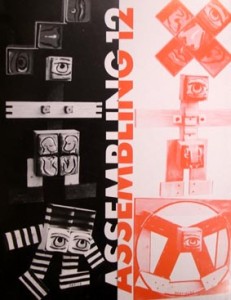
Kunstverein presents Openings & Closings –
The Richard Kostelanetz Bookstore
2 July – 1 October 3011
Richard Kostelanetz (born 1940, New York) is an American writer, artist, critic, and editor of the avant-garde. He is infamous for his prolific and often biting prose. In his short fictions (some only 2 words long) and visual poetry, RK employs a radically formalist approach consisting of arrangements of words on a page using such devices as linking language and sequence, punning, alliteration, parallelism, constructivism, and minimalism. His literary work challenges the reader in unconventional ways and is often printed in limited editions at small presses. Kostelanetz’s nonfiction work The End of Intelligent Writing: Literary Politics in America (1974) charged the New York literary and publishing establishment with inhibiting the publishing and promotion of works by innovative younger authors. Among his other works are Recyclings: A Literary Autobiography (1974, 1984), Politics in the African-American Novel (1991), Published Encomia, 1967-91 (1991), On Innovative Art(ist)s (1992) and A Dictionary of the Avant-Gardes (1999, 2001). In 1970 Kostelanetz co-founded and directed the innovative annual aptly called Assembling; thirteen editions of “otherwise unpublishable” art and literature, including the Complete Assembling were produced between 1970 and 1982. Now scarce, Kunstverein will have the complete set of Assembling 1 through 13 on view. Also available will be the many recordings and audiocassettes issued on RK’s own label, as well as critically acclaimed edited works on B.B. King, Merci Cunningham, John Cage and Gertrude Stein.
For reasons closely connected to Kostelanetz’s practice we feel it is consistent that Kunstverein becomes a Bookstore dedicated to the artist – as a more viable alternative to a straight forward retrospective. The Richard Kostelanetz Bookstore will host and sell all of RK’s publications (over 80 titles). As well, rare artifacts, editions and smaller artworks will be on view in the secret backroom. Richard Kostelanetz’s role since the late 60s has been one of instigator, assembler, editor, artist and journalist. This multi-relational practice is not only historically significant, it is unquestionably inspirational and exemplary for the present.
Openings & Closings – The Richard Kostelanetz Bookstore is conceived in dialogue with Hyo Kwon and Goda Budvytyte
gammm su smemoranda

Against Expression
“Faldone”, di Vincenzo Ostuni _ (inserimenti e varianti)

per lettere grosse
la pagina di riferimento, per inviare testi a lettere grosse, è questa.
testi che non seguono tutte le indicazioni della pagina non possono essere passati in lettura.
dal 16 al 25 giugno, a Parigi: Collective Generation artists’ books show
from Charles Bernstein’s blog:
« Au Plaisir du Livre » : « Collectif Génération » et les nouvelles perspectives du livre d’artiste
the grand series published by Gervais Gassaud.
Librairie Auguste Blaizot, Paris
Poets:
BRESIL: Régis BONVICINO
ETATS UNIS: John ASHBERY, Charles BERNSTEIN, Jerome ROTHENBERG, Raphaël RUBINSTEIN.
FRANCE: Marilyne DESBIOLLES, Fabrice MELQUIOT, Claude MINIERE,
ITALIE: Nanni BALESTRINI
JAPON: Kenji NAGAKAMI
MEXIQUE/ETATS UNIS: Monica de la TORRE
Artists:
Angleterre: Stephen BUCKLEY , David TREMLETT
Argentine: Miguel Angel RIOS, Sergio VEGA
Brésil: Elida TESSLER
Chine: Yang YONGLIANG
Corée du Sud: Jeong Hwa CHOI
Etats Unis: Susan BEE, Elana HERZOG, Suzanne Mc CLELLAND, Jill MOSER, Archie RAND,
Judith SHEA.
France: Jean CLAREBOUDT, Dominique FIGARELLA, Dominique LIQUOIS, Philippe MAYAUX,
Bernard PIFFARETTI.
Italie: Elena BERRIOLO, Marco GASTINI, Giorgio GRIFFA.
Malaisie: H.H. LIM
Mexique: Carlos AMORALES
Portugal: Julião SARMENTO
République Tchèque: Jiri CERNICKY
SOUS LES PAVÉS: new issue
from The Other Room:
SOUS LES PAVÉS is a quarterly newsletter of poetry & ideation
featuring
- Brooks Johnson
- Rodrigo Toscano
- Emily Critchley
- William Fuller
- Linh Dinh
- Roberto Harrison
- John Beer
- Tyrone Williams
- Tim Atkins
- j/j hastain
- Jerome Rothenberg
- Hoa Nguyen
- Mary Burger
- Sotère Torregian
- The Rejection Group
- Brenda Iijima
- Micah Robbins
- Edmond Caldwell
- Frances Kruk
- Warren Craghead
*
download the pdf here
replica: Prosa e poesia / l’intervista uscita su “L’Ulisse” n.13
POESIA E PROSA
_
ripubblico qui le mie risposte al questionario de “L’Ulisse” n. 13 (uscito ad aprile 2010):
http://www.lietocolle.info/upload/l_ulisse_13.pdf
_
1. Qual è la sua idea di prosa? Come si definisce il suo approccio alla prosa (anche rispetto alla questione dei generi)?
La mia idea di prosa è ovviamente anche un’idea o massa-matassa non solo mia: è di fatto trasmessa, sovrascritta: è una cosa e una casa anche altrui, costantemente. Precisamente per il fatto di appartenermi, è altra, composita, giocoforza differenziale, effusa direi anzi dissipata ossia sprecata in diffrazioni, prassi e diversioni da prassi (da quelle prediffuse, usurate). È cioè una specie di gomma-somma non aritmetica e anzi mosaico o ventaglio di eredità, microlabirinti e ricodifiche, giostre in buona parte e assai volentieri disallineate dall’usuale asse e traccia playback della prosa che si legge nei libri degli editori generalisti.
(Rispetto a questi ultimi trovo, semmai, e spesso, consonanza felice fra prosa scritta mia e flusso parlato casuale, eavesdropping, banalità da bar, eccetera: però, anche lì, è il quid normante del normale a indispettirmi. Il già dato, il precompreso, il predetto, quanto si sa e si vuole già letto dall’ebetudine dello spettatore di pagina o di festa aggiornato che si fa dire da giornali e inserti cos’è che deve scandire, ritenere, immettere in chat).
Quanto a(l) “me” in abito di lettore-lettore talvolta agìto, che cioè si sa e si vuole ingenuo, ben volentieri spendo tempo sulle pagine di Bram Stoker. Per dire. Non avanzo però molto in qua nel presente, se si tratta di cose così. Stili e modi così. Racconto-racconto. Certo, uno vede il gazzettone, la tabula recensoria dei best editoriali, e si domanda: ma quale roba non è così, in scaffale? Un esercito di marchese e contesse e raccontesse fanno le gare di puntualità. Il tè si serve alle cinque spaccate. Chi c’è c’è. (Ci stanno tutti).
Al posto della “figura dell’editor”, Continua a leggere
su 3AM

*
8 asemic poems: http://www.3ammagazine.com/3am/eight-poems-marco-giovenale/
interview: http://www.3ammagazine.com/3am/maintenant-65-marco-giovenale/
*
su PCritico
la recensione di Cecilia Bello Minciacchi a Shelter è in Punto critico
da oggi: http://puntocritico.eu/?p=2329
*