Archivi categoria: vispo & gif

Their Wired Lives Wore Hazel-Dim / Matina Stamatakis


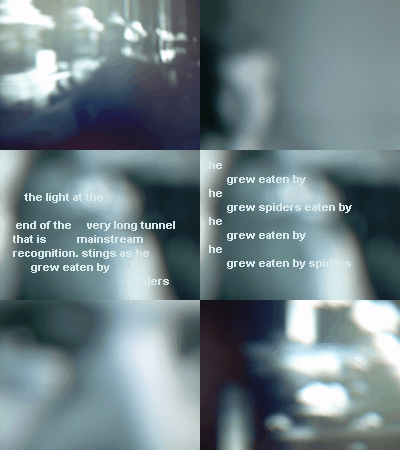
1.cerebral plastids once wept [starchy/thin[e] cortex] broken,
membranous, firmament: trigonometries full of clouds above heads
barometric flux, spun rivets before air


2. eternity bivouacking solitude fortuitous yellows on nicotine
thumbs : re: they fancied conspirators in the [d]rains, conjured
[e]motion in glass, magazines, endothermic bodies elastic ion
bombardment re: dirty square, angling submonolayers [in film languages
disperse across grain–]


3.surfacing by strain in silicide re: kinetics, they stared at a blank
wall and found their eyes trailed vein-work of peeling paint: re:
osmosis–they found water concentrated in the middles of their palms]
all surfaces diffused.


Words to Be Looked At

Words to Be Looked At
Language in 1960s Art
Liz Kotz

Table of Contents

Language has been a primary element in visual art since the 1960s–whether in the form of printed texts, painted signs, words on the wall, or recorded speech. In Words to Be Looked At, Liz Kotz traces this practice to its beginnings, examining works of visual art, poetry, and experimental music created in and around New York City from 1958 to 1968. In many of these works, language has been reduced to an object nearly emptied of meaning. Robert Smithson described a 1967 exhibition at the Dwan Gallery as consisting of “Language to be Looked at and/or Things to be Read.” Kotz considers the paradox of artists living in a time of social upheaval who used words but chose not to make statements with them.

Kotz traces the proliferation of text in 1960s art to the use of words in musical notation and short performance scores. She makes two works the “bookends” of her study: the “text score” for John Cage’s legendary 1952 work 4’33”–written instructions directing a performer to remain silent during three arbitrarily determined time brackets– and Andy Warhol’s notorious a: a novel–twenty-four hours of endless talk, taped and transcribed–published by Grove Press in 1968. Examining works by artists and poets including Vito Acconci, Carl Andre, George Brecht, Douglas Huebler, Joseph Kosuth, Jackson Mac Low, and Lawrence Weiner, Kotz argues that the turn to language in 1960s art was a reaction to the development of new recording and transmission media: words took on a new materiality and urgency in the face of magnetic sound, videotape, and other emerging electronic technologies. Words to Be Looked At is generously illustrated, with images of many important and influential but little-known works.

Liz Kotz writes on contemporary art and on interdisciplinary avant-gardes of the postwar era. She teaches in the Art History Department at the University of California, Riverside.

§

Endorsements

“In 1959, Brion Gysin famously claimed that poetry was fifty years behind painting. Gysin’s prophecy still holds true: half a century later, contemporary poetry is just beginning to explore ideas forged by language-based artists in the 1960s. As such, this book is a roadmap, bursting at the seams with inspiration and ideas for current literary practices. By embracing an intermedia approach–one where music, photography, visual art, poetry and performance all live in the same room–Liz Kotz elegantly creates a compelling portrait of our digitized networked present. The implications are radical: by gazing backwards, this book predicts the future.”
Kenneth Goldsmith, University of Pennsylvania

Words to Be Looked At is a landmark account of the central story of post-war art: the first sustained investigation of the ‘linguistic turn’ that has defined the arts since the 1960s. As Kotz details with unequalled authority and insight, language became a primary media for artists in many movements–from Pop to Fluxus to Minimalism to Conceptualism–at the same time that the recognition of its materiality permitted an unrivaled experimentation in literature. The American art of the 60s, we learn, put French post-structural theory into radical practice. Combining theoretical sophistication with archival discoveries, Kotz’ truly interdisciplinary scholarship allows her to reestablish the dialogue–between experimental music, avant-garde literature, visual art, performance and photography–that made the art of the period so exciting and that continues in the most vital work of our own moment.”
Craig Dworkin, Department of English, University of Utah

“Of the many strengths of Words to be Looked At Kotz’s synthetic vision stands out. She has a gift for bringing together previously isolated works in ways that illuminate both elements of her comparison. The discussion of John Ashbery and Jackson MacLow offers us a superb example of this within the domain of poetry, while the chapter on George Brecht’s performance piece and Joseph Kosuth’s photographic installation provides a model for the synthesis of different arts.”
P. Adams Sitney, Director, Program in Visual Arts, Princeton University

View All Endorsements

TEXT LOSES TIME by Nico Vassilakis

ManyPenny Press is pleased to announce the release of TEXT LOSES TIME by Nico Vassilakis. This work spans roughly 15 years of the author’s efforts in both textual and visual writing. It is Vassilakis’’ first full-length book.

TEXT LOSES TIME

Afterword by Nick Piombino

188 pp.

ISBN-10: 0-9798478-0-X

ISBN-13: 978-0-9798478-0-6

AUTHOR’S STATEMENT:

This book intends to present both verbal and visual poetries as equal. Though notions of poetics have shifted and swerved, what has stayed solid throughout is that the alphabet, the word – however arranged –contains, within it, dual significance. First, the proto-historic role of the visual conveyance of represented fact. Second, the overriding desire of human utterance to substantiate existence. In conjoining these two models this book hopes to form a third, blurred value. Thought and experience are factors that accrue, while staring and writing help resolve and conclude. Text itself is an amalgam of units of meaning. As you stare at text you notice the visual aspects of letters. As one stares further, meaning loses its hierarchy and words discorporate and the alphabet itself begins to surface. Shapes, spatial relations and visual associations emerge as one delves further. Alphabetic bits or parts or snippets of letters can create an added visual vocabulary amidst the very text one is reading. One aim, to this end, is to merge and hinge visual and textual writing into workable forms. This book collects some of these experiments.

AUTHOR BIOGRAPHY:

Nico Vassilakis was born in New York City in 1963. He has co-written and performed a one-man play about experimental composer Morton Feldman. Vassilakis is co-founder and curator for the Subtext Reading Series and editor of Clear-Cut: Anthology (A Collection of Seattle Writers). He has been a guest-editor of WOS#35: Northwest Concrete and Visual Poetry and his visual poetry videos have been shown worldwide at festivals and exhibitions of innovative language arts. In 1998, Vassilakis co-produced, with Rebecca Brown, a 24-hour “Gertrude Stein-a-thon.” His work has appeared in numerous magazines, including Ribot, Caliban, Aufgabe, Chain, Talisman, Central Park and Golden Handcuffs Review. He works for Fantagraphic Books and lives in Seattle with his son, Quixote.

BOOKS:

Askew (bcc press), Stampologue (RASP), Orange: A Manual (Sub Rosa Press), Diptychs: Visual Poems (Otolith), Pond Ring (nine muses books), sequence (Burning Press), Enoch and Aloe (Last Generation Press), The Colander (housepress), Flattened Missive (P.I.S.O.R. Publications), Species Pieces (g o n g press), KYOO (Burning Press) and others.

DVD:

CONCRETE: Movies (Sub Rosa Press)

CONTACT AND ORDERING INFORMATION:

ManyPenny Press
1111 E. Fifth St.
Moscow, ID 83843

$15.95 + $2 postage
Make checks payable to Crag Hill
(Pre-orders will be sent post-paid)

Su Jukka-Pekka Kervinen


ripropongo qui un saggio sul lavoro di J.-P. Kervinen uscito su gammm alcuni mesi fa


1.

È significativo il nickname che Jukka-Pekka Kervinen usa nel blog http://selfsimilarwriting.blogspot.com/: asemic. Il sottotitolo del blog è “asemic texts in fractal dimensions”.

“Asemic” (in dimensioni di moltiplicazione indefinita: frattali) è un termine che positivamente sintetizza un buon numero delle strade stilistiche che l’artista ha intrapreso e organizza e costruisce/disfa: un percorso asemico, prima che asemantico. Attraverso accumuli orientati di ’soluzioni’, demolisce e complica e dunque rimette in gioco la stessa più ampia categoria del ‘risolvere’.

(Non troppo diversa è la prassi di accostamento e accumulo di variabili seguita da Jim Leftwich, che non a caso ha fittamente collaborato con Kervinen: cfr. http://telephonepoles.blogspot.com/, http://jimleftwichtextimagepoem.blogspot.com/ e i vari link legati).

I testi ‘quasi’ intraducibili di Kervinen raccolti in ow oom [pdf 64 Kb] per gammm vanno in questa direzione. In ow oom le lacune suggeriscono e ritraggono senso. Spostano e deviano e dislocano e slogano segni alfabetici e nessi semantici sulla pagina ogni volta un istante prima del riconoscimento, generando in questo modo molte false/possibili tracce, in accumulo così fitto da portare a quel conclusivo effetto-eco da “nessuna traccia” (e “nessun segno”, asemìa) che persuade il lettore ad affinare la ricerca, a ricostruire/tentare e sciogliere daccapo i legami spezzati.

Molte frasi e segmenti di senso sono ricostruibili colmando (o sentendo di dover colmare) le lacune, i tratti bianchi, le ambiguità, le sospensioni e anfibologie. Inoltre – elemento non secondario – proprio quell’eco finale vuota sottintende la necessità di una indagine non superficiale sulle più ampie promesse e sugli irraggiamenti di significato che una prassi asemica paradossalmente innesca, può innescare.


2.

A chi visiti le numerosissime opere-blog di Kervinen (spesso e significativamente nate senza intenzione di trasformarsi in ‘libro’: veri oggetti elettronici dunque) appare chiaro come si generi una sorta di energia complessiva dalle sue strutture e sculture – risultante da un poliedro di linee e forze date da immagini videopoemi testi sovrapposizioni interazioni e collaborazioni con altri autori.

Questo, di fatto, non avviene in virtù della singola pagina o del singolo lavoro grafico, ma direi all’interno della prassi ampia, del ventaglio aperto di tutte le sue operazioni, nell’accumulo parossistico delle stesse, in innumerevoli post, anche solo grafici o con labili tracce alfabetiche (cfr. http://codes-writing.blogspot.com/).

E il carattere del lavoro complessivo si rintraccia a sua volta in singoli esperimenti.

Pensiamo ai monumentali blocchi di sequenze coese in http://tc44.livejournal.com/: ci si rende conto che nessuna competenza linguistica umana potrebbe tener dietro alla piramide di rapporti aggettivali e nominali che lì viene attivata. Dopo due-tre righe fitte di nomi che fungono da apposizioni di altri nomi in sequenza interminabile, il filo è perso. Il dato e dado “asemico” è lanciato: le sue facce si moltiplicano, il poliedro tende alla sfera.

Anche questo è un modo di fare scrittura – e più in generale arte – installativa. Il lavoro di Kervinen dimostra di poter essere – in definitiva ed essenzialmente – VISTO. Sondato, scorso, non ‘letto’, non linearmente scansionato. (Cfr: http://nonlinearpoetry.blogspot.com/: “bifurcations, state machines and nonlinear dynamics”).

Il discorso installativo (non sempre: ma in alcuni casi) letteralmente disintegra e disperde attese semplificate e sguardo, aggredisce le decodifiche facili man mano che queste si tendono sulla pagina, e così obbliga il lettore a riletture e diversioni, a una filologia accanita nell’invenzione/ritrovamento di nessi semantici. (Che non ‘mancano’: piuttosto, sono esplosi in latenze, moltiplicati in ’segni meno’, negazioni).

Sfido chiunque a rimanere legato a un’idea di lettura lineare di questi blocchi, di queste vere e proprie sculture nominali.


5 months with THE FLUX I SHARE

flux i shareSeptember 9th, 2007 ::: our fluxishare is 5 months old !

§

THE FLUX I SHARE is a collaborative webspace where some people meet to share experiments. here’s a selection from a first table of contents:

something like a situationist state of mind. 00
fragments. reduced time. weakness and/or defeat. 01
passages. paris. rome. ny. & anywhere. in any language. 02
“images and visual poems are welcome”. 03
experimental codes are daily stuff. 04
each single day produces (non)sense, superimpositions, etc. 05
prosperous flux(for)us. phosphorus-added googled daydiagrams. 06
reality is enough. don’t double it. overwrite. 07
no performance. no show. install. minimal texts (or not). 08

*

the crew: bill allegrezza, gherardo bortolotti, anne boyer, alessandro broggi, david-baptiste chirot, crashtest, rachel defay-liautard, michelle detorie, linh dinh, clifford duffy, susana gardner, marco giovenale, k. lorraine graham, jukka-pekka kervinen, drew kunz, jim leftwich, jon leon, sheila murphy, lanny quarles, carmen racovitza, joe ross, eric k. rzepka _ e-doppelganger, jennifer scappettone, ed schenk, spencer selby, matina l. stamatakis, harry k. stammer, ton van ‘t hof, elisabeth workman, michele zaffarano