DADA MAGAZINES The Making of a Movement by Emily Hage Ava Publishing, 2022
Dada magazines made Dada what it was: diverse, non-hierarchical, transnational, and defiant of the most fundamental artistic conventions. This first volume entirely devoted to Dada periodicals retells the story of Dada by demonstrating the centrality of these graphically inventive, provocative periodicals: Dada, New York Dada, Dada Jok, and dozens more that began crossing enemy lines during World War I. The book includes magazines from well-known Dada cities like New York and Paris as well as Zagreb and Bucharest, and reveals that Dada continued to inspire art journals into the 1920s. Anchored in close material analysis within a historical and theoretical framework, Dada Magazines models a novel, multifaceted methodology for assessing many kinds of periodicals. The book traces how the Dadaists-Marcel Duchamp, Tristan Tzara, Dragan Aleksic, Hannah Höch, and many others-compiled, printed, distributed, and exchanged these publications. At the same time, it recognizes the journals as active agents that engendered the Dada network, and its thematic, chronological structure captures the constant exchanges that took place in this network. With in-depth scrutiny of these magazines-and 1970s “Dadazines” inspired by them-Dada Magazines is a vital source in the histories of art and design, periodical studies, and modernist studies.
CLEMENTE PADÍN y JORGE CARABALLO poesía visual 1960-2000 editado por Riccardo Boglione Entreacto vía Sant’Agnese 19R – Génova – ITALIA 6 diciembre 2022 – 13 enero 2023 Horas: Miércoles – Viernes 16-19 inauguración: Sábado 6 de diciembre, 18 h La exposición pretende ser un primer acercamiento, sucinto, en Italia, a la producción de los uruguayos Clemente Padín (1939) y Jorge Caraballo (1941-2014) en el campo de la poesía visual, y una oportunidad para ver publicaciones que son difíciles de encontrar, recordando también como algunas obras de los dos poetas aparecieron en revistas experimentales italianas y europeas de los años 70 y 80. Luego de cinco años dedicados a inquietar al estamento literario uruguayo a través de la revista Los Huevos del Plata (1965-1969), en el paso de los años 60 y 70 Clemente Padín se abre, y en consecuencia se dedica a la mezcla de imágenes y palabras. En ese contexto, por tanto, experimentará incesantemente (llegando a tocar una “poesía inobjetual”, reducida a un gesto) y difundirá en Uruguay las tensiones globales vinculadas a lo verbal-visual a través de la revista Ovum 10 (1969-1972) y diversas exposiciones. En este período, la producción de Padín se balancea constantemente entre obras destinadas a investigar la forma -en la exposición representada por los “signos” de 1968-69- y otras directamente implicadas en cuestiones sociopolíticas -por ejemplo en las editoriales ilustradas de Ovum 10 o en la actividad del arte-correo – si bien la urgencia política se hará más apremiante sobre todo a partir de 1973, cuando se instaura la dictadura en Uruguay. Padín pagó el precio de su militancia, aunque principalmente artística, cuando fue detenido, junto a Jorge Caraballo, en 1977 y luego liberado, nuevamente junto a Caraballo, dos años después, aunque en libertad condicional. Artistas de todo el mundo se movilizaron para el estreno de los dos y algunas piezas expuestas así lo atestiguan. La figura de Caraballo, que inicia su aventura verbal-visual hacia 1973, proviene en cambio de la pintura, y volverá a la pintura, sobre todo, a finales de los años 80, dedicándose a la producción de refinados cuadros op-art cinéticos, sin embargo abandonando por completo las obras verboicónicas. Su paso por la poesía visual es sumamente significativo e intenso, ligado a la denuncia de la represión militar y el involucramiento de Estados Unidos en las tramas dictatoriales de América Latina en los años 70. Autor de obras que coquetean con lo conceptual, como algunos pequeños libros artista, y donde el papel de la fotografía se vuelve central, Caraballo vincula su estilo a una ironía erosiva que medita sobre el soporte, siempre precario y pobre (por ejemplo, la fotocopia) y sobre los conflictos ideológicos de su tiempo. Imagen: Jorge Caraballo, IBM, 1984
Quarto Pianeta Festival IL PIEDE
Scultura teatrale di Dario Bellini ex O.P., via Giovanni Maggio 4 – Genova Quarto
Aula 7
sabato 22 ottobre 2022, ore 19:00
cliccare per ingrandire
Il Piede di Filippo Tommaso Marinetti, andato in scena al teatro Dal Verme di Milano nel 1915 e mai più rappresentato, aveva, secondo le ricostruzioni, la quarta parete aperta su un baratro spazio-temporale.
Riapparso in sogno con tutti i dettagli della messa in scena all’autore nel 2015 costituisce il primo dei quattro livelli di una scultura teatrale di Dario Bellini.
Primo livello: Il piede, appunto, inedita e plausibile pièce di Marinetti;
Secondo livello: l’interazione polemica col pubblico;
Terzo: arte sull’arte, annoso meta-testo tra la pressione degli eventi e le ragioni dell’arte;
Infine quarto livello: gli slogan, i diktat inamovibili cui siamo incatenati.
Il piede, così concepito, è una commedia con un epilogo patetico e senza alcuno sviluppo.
Il pubblico è diviso in due per ricostruire idealmente un confronto tra il pubblico della prima rappresentazione nel 1915 e il pubblico di oggi.
Ciascuno vede solo una parte dello spettacolo, ma sente le voci di entrambi i lati.
Il primo livello è diretto da un regista (Andrea Manni), il secondo ed il terzo da un altro regista (Dario Bellini). Il quarto livello è gettato nelle probabilità del caso.
La scultura teatrale descrive mediante le parole un profilo nell’aria come si trattasse di una normale scultura.
Il profilo si delinea coi pensieri. Non è teatro! Sembra, teatro, ma non è teatro. Non è 900! Sembra, 900, ma non è novecento. Continua a leggere→
LINDSAY CAPLAN Arte Programmata Freedom, Control and the Computer in 1960s Italy University of Minnesota Press, 2022
Tracing the evolution of the Italian avant-garde’s pioneering experiments with art and technology and their subversion of freedom and control In postwar Italy, a group of visionary artists used emergent computer technologies as both tools of artistic production and a means to reconceptualize the dynamic interrelation between individual freedom and collectivity. Arte Programmata traces the multifaceted practices of these groundbreaking artists and their conviction that technology could provide the conditions for a liberated social life.
_____
Lindsay Caplan’s Arte Programmata offers a compelling account of a group of lesser-known artists affiliated with the Italian Arte Programmata movement, whose experimental art and design practices, emerging in the nascent years of computerization, pointedly (and presciently) engaged with political questions around freedom and control, individuality and collectivity. Beautifully written, sharply analytic, and free of jargon, Caplan’s incisive study should find a place on the bookshelves of anyone interested in the roots and impacts of technological change.
— Janet Kraynak, author of Contemporary Art and the Digitization of Everyday Life
GIULIO PAOLINI Quando è il presente? a cura di Bettina Della Casa e Sergio Risaliti Polistampa, 2022
“Il volume nasce dal progetto espositivo che nel 2022 ha coinvolto le sale del Museo Novecento e del Convento di San Marco di Firenze. La mostra ha ripercorso le ultime riflessioni di Giulio Paolini sul significato della creazione artistica e sulle sue molteplici implicazioni, combinando gli interrogativi sull’arte con quelli sull’esistenza e il suo fluire. Con la raffinatezza che da sempre caratterizza il suo lavoro, l’artista si sofferma sul valore del tempo e sulla nostra impossibilità di afferrarlo, in un’indagine che appare oggi ispirata a una più profonda meditazione sull’inarrestabile scorrere dei giorni. In questo percorso, necessariamente individuale pur nella sua universalità, Paolini ci fa immergere in uno spazio costellato di richiami al crepuscolo della vita e agli enigmi che segnano il nostro passaggio su questa terra: un tragitto scandito da istanti infiniti, in cui si annida, nonostante tutto, l’eternità”.
MAURIZIO GHELARDI
Aby Warburg, uno spazio per il pensiero
Carocci, 2022
Il volume ripercorre, anche alla luce del materiale inedito, alcuni momenti salienti della riflessione di Aby Warburg, che complessivamente appare simile alla rete tessuta da un ragno. Warburg ha sempre cercato di frantumare e metabolizzare ogni disciplina. Per tutta la vita il suo intento è stato quello di ampliare la ricerca sulla vita psicologica grazie a un metodo “psicostorico”, e di indagare aspetti e figure dell’espressione e dell’esistenza attraverso la variabile che si interpone tra l’esperienza figurativa e il linguaggio parlato. Anche l’Antico è concepito da Warburg come la declinazione storica di un problema costitutivo della percezione e dell’espressione umane che rimanda a un presupposto di carattere antropologico. Questa raccolta di saggi getta nuova luce su quella che egli stesso definì la sua lotta contro i «guardiani dei confini».
ARTHUR RIMBAUD Scritti africani traduzione e cura di Gabriel-Aldo Bertozzi Diana edizioni, 2022
Le pagine redatte da Rimbaud durante il periodo africano rivelano aspetti inediti della sua personalità. Con l’Europa Rimbaud abbandona la poesia per un nuovo linguaggio, una letteratura odeporica ed epistolare, tutta sua: resoconti pionieristici e reportages di viaggio, da “inviato speciale”, coi quali descrive le tradizioni, la cultura, i costumi dei popoli esplorati. E poi la corrispondenza: le lettere alla madre, alla sorella, agli amici, in cui le impressioni e le osservazioni personali danno il polso della sensibilità, dell’emotività, degli interessi, del carattere dell’uomo; fino alla descrizione più tragica: l’amputazione della gamba e i giorni della fine. Questa edizione, con una traduzione e uno studio critico del tutto nuovi, presenta gli Scritti africani come la “Terza Opera” di Rimbaud dopo le Illuminazioni e Una Stagione all’inferno, offrendo al lettore una chiave interpretativa dell’intera produzione del poeta francese. Arthur Rimbaud (1854-1891), emblematica figura di scrittore ribelle e spregiudicato, poeta decadente e “maledetto” per antonomasia. Il suo mito non ha mai cessato di affascinare generazioni di lettori, artisti e letterati. Fu coinvolto negli scandali dovuti alla sua turbolenta amicizia con Paul Verlaine. In seguito abbandonò progressivamente la poesia; nel 1873 esce Una Stagione all’inferno e nel 1886 le Illuminazioni, “prose poetiche” pubblicate da Verlaine. Dal 1874 al 1879 vagabondò per l’Europa e nel 1880 partì come agente commerciale: ad Aden (Yemen) a Gibuti e ad Harar (Etiopia). Un decennio di esplorazioni e viaggi alla ricerca della ricchezza con ogni sorta di traffici. Poi la malattia, il ritorno a Marsiglia nel giugno del 1891, l’amputazione di una gamba e, poco dopo, la morte.
Gabriel-Aldo Bertozzi, artista e accademico, teorico dell’arte e della letteratura, fondatore dell’Inismo (Parigi, 1980), condirettore della rivista Bérénice. È tra i massimi conoscitori dell’opera e della figura di Arthur Rimbaud.
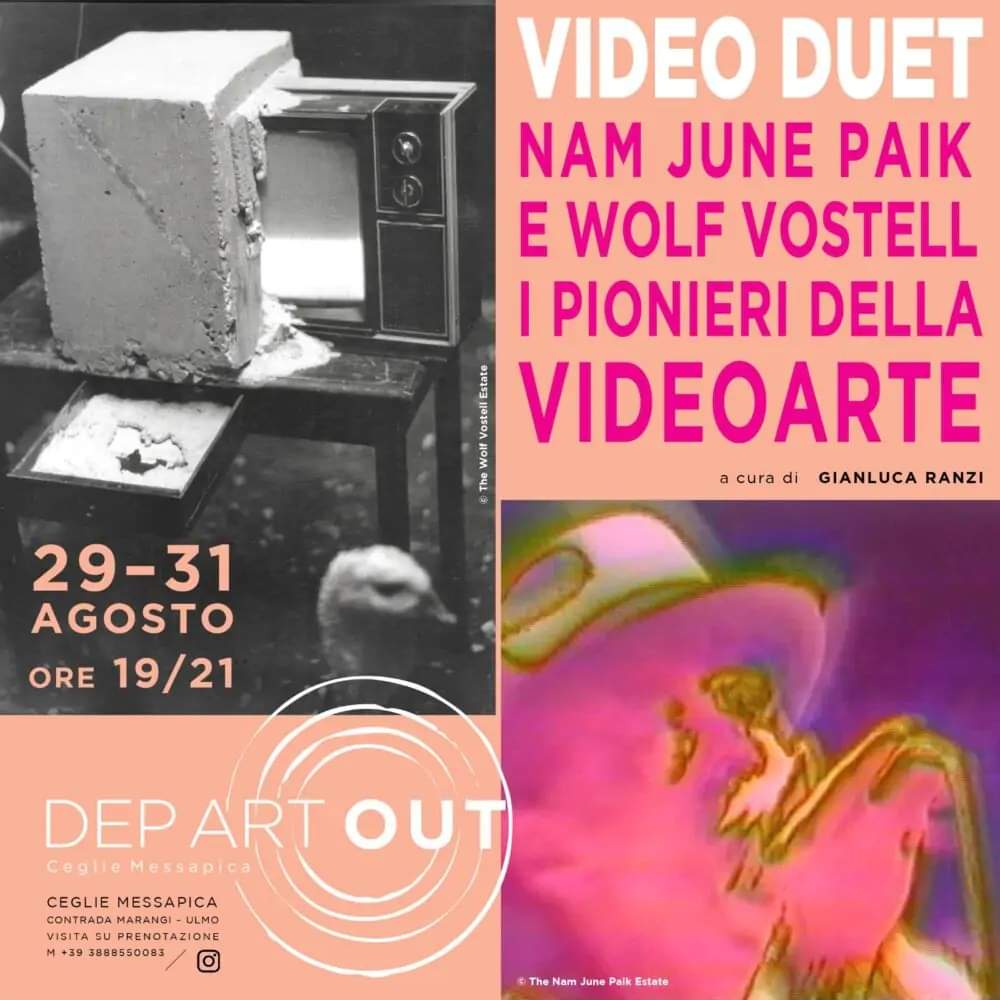
VIDEO DUET Nam June Paik e Wolf Vostell I pionieri della Video Arte a cura di Gianluca Ranzi Dep Art Out, Ceglie messapica 29-31 agosto 2022
Il 29, 30 e 31 agosto, dalle 19 alle 21, occhi puntati sui pionieri della videoarte Nam June Paik e Wolf Vostell, in dialogo, anzi, in “Video Duet”, a cura di Gianluca Ranzi.
Nato nel 1932 a Seoul e morto a Miami nel 2006, Nam June Paik è stato uno degli artisti più influenti della seconda metà del XX secolo, a partire dalle sue sperimentazioni nell’ambito del movimento Fluxus. Per “Video Duet” sarà presentato l’omaggio di Nam June Paik all’amico Joseph Beuys, un filmato manipolato elettronicamente della loro performance tenuta il 2 giugno 1984 alla Sogetsu Hall di Tokyo. Il video, presente nella videoteca della Fondazione Mudima, che nel 1990 ha ospitato la personale dell’artista coreano e nel 1994 ha curato la sua mostra all’Arengario di Milano, evidenzia l’interazione performativa tra la vocalizzazione sciamanica di Beuys e l’esecuzione di Paik al pianoforte di motivi classici e di canzoni tradizionali giapponesi. «La visualizzazione del suono, l’intermedialità e la mobilitazione fantastica del linguaggio ottenuta attraverso la tecnologia, contraddistinguono l’opera di Paik e raggiungono in questo video una particolare intensità poetica».
Rimaniamo ancora nel Fluxus con Wolf Vostell (1932-1998), che fu tra i promotori dell’Happening in Europa e, dal 1959, iniziò a realizzare opere con il coinvolgimento attivo dei media tecnologici, manipolando televisori e apparecchi audio-visivi di ogni sorta, spesso inserendoli all’interno delle sue action-dé-coll/age. Nel video di Endogene Depression, qui nella versione presentata nel 1980 all’Institute of Contemporary Art di Los Angeles, la presenza dei televisori, inglobati nel cemento, alcuni dei quali accesi e con il suono e l’immagine manipolati elettronicamente, è associata al girovagare dei tacchini, a sottolineare il contrasto tra l’artificialità della macchina e la verità del mondo naturale. «A differenza di Paik, come emerge da questo video, Wolf Vostell si preoccupa quindi di criticare gli effetti imposti dalla televisione come rituale schizofrenico e alienante».
PAOLO RUFFINO Future Gaming Creative Interventions in Video Game Culture Goldsmith Press, 2018
This book is not about the future of video games. It is not an attempt to predict the moods of the market, the changing profile of gamers, the benevolence or malevolence of the medium. This book is about those predictions. It is about the ways in which the past, present, and future notions of games are narrated and negotiated by a small group of producers, journalists, and gamers, and about how invested these narrators are in telling the story of tomorrow.
This new title from Goldsmiths Press by Paolo Ruffino suggests the story could be told another way. Considering game culture, from the gamification of self-improvement to GamerGate’s sexism and violence, Ruffino lays out an alternative, creative mode of thinking about the medium: a sophisticated critical take that blurs the distinctions among studying, playing, making, and living with video games. Offering a series of stories that provide alternative narratives of digital gaming, Ruffino aims to encourage all of us who study and play (with) games to raise ethical questions, both about our own role in shaping the objects of research, and about our involvement in the discourses we produce as gamers and scholars. For researchers and students seeking a fresh approach to game studies, and for anyone with an interest in breaking open the current locked-box discourse, Future Gaming offers a radical lens with which to view the future.
STEPHANIE CHADWICK Jean Dubuffet, bricoleur. Portraits, Pastiche, Performativity Ava Publishing, 2022
Celebrating Art Brut (the art of ostensible outsiders) while posing as an outsider himself, Dubuffet mingled with many great artists, writers, and theorists, developing an elaborate and nuanced stream of conceptual resources to reconfigure painting and reframe postwar anticultural discourses. This book reexamines Dubuffet’s art through the lens of these portraits (a veritable who’s who of the Parisian art and intellectual scene) in tandem with his writings and the art and writings of his Surrealist sitters. Investigating Dubuffet’s painting as bricolage, this book reveals his reliance upon an anticulture culture and the appropriation of motifs from Surrealism to the South Pacific to explore the themes of multivalence, performativity, and multifaceted identity in his portraits.
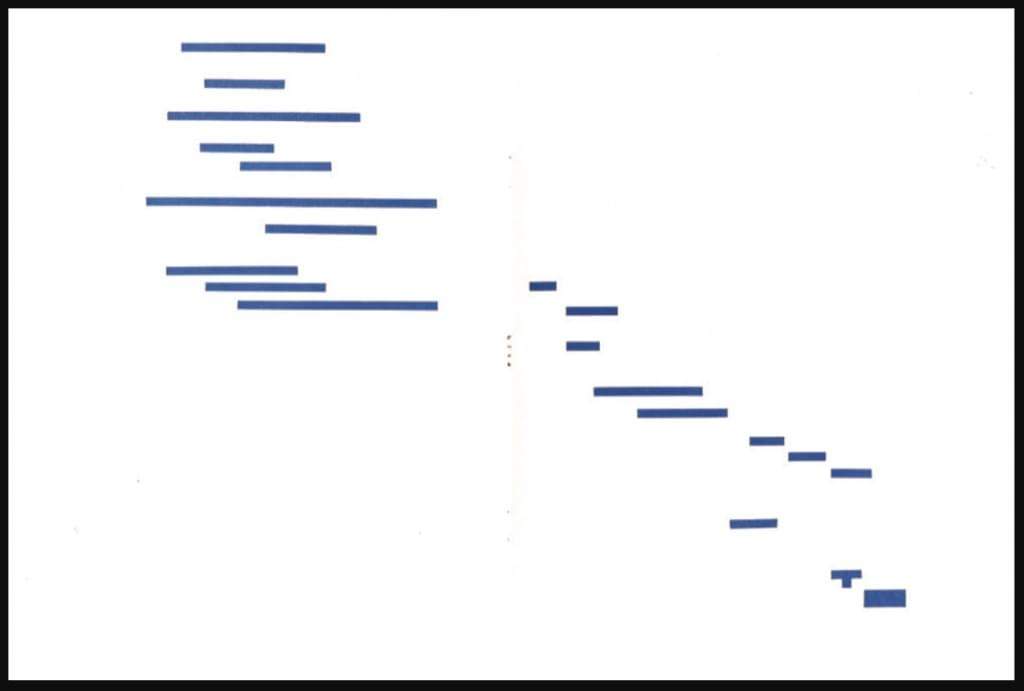
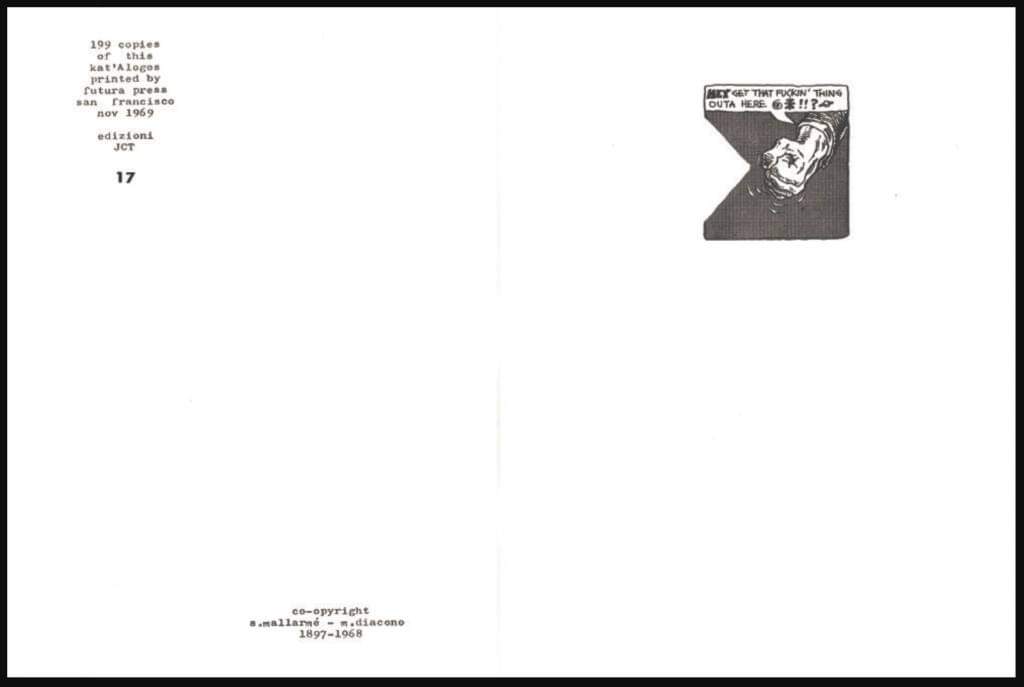
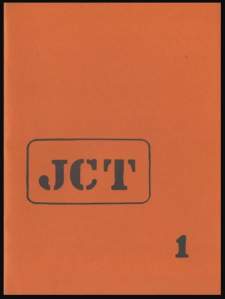
MARIO DIACONO a METRICA n’aboolira JCT, San Francisco, 1969
Libro d’artista costituito da tre pagine introduttive con un fumetto detournato a cui segue il frontespizio stampato in nero e arancio. Le altre pagine sono percorse da strisce variamente disposte orizzontalmente, di diversa larghezza e lunghezza e di colore arancio e bleu: chiara ripresa in termini esclusivamente visuali dell’opera di Stéphane Mallarmé «Un coup de dès jamais n’abolira le hazard» nell’edizione Gallimard pubblicata postuma (1914), in cui le parole sono disposte variamente sulla pagina bianca secondo le disposizioni del poeta.
La stessa operazione artistica viene compiuta nello stesso anno da Marcel Broodthaers con il suo: «Un Coup de Dés Jamais N’Abolira Le Hasard. Image»: le parole del testo di Mallarmé sono sostituite da strisce nere corrispondenti esattamente al layout tipografico usato per articolare il testo originale: i versi vengono resi illeggibili e le pagine trasformate in immagini. E’ da notare che l’anno di pubblicazione del libro di Diacono è il 1969 come dichiarato al colophon e non il 1968 come dichiarato in varie bibliografie. “1968” è semplicemente l’anno di redazione, indicato al frontespizio e nel copyright: “S. Mallarmé – M. Diacono 1897-1968”.
“Quando costruivo JCT 1 [A metrica n’aboolira], non avevo idea di cosa Broodthaers stesse facendo. Certamente qualcosa “era nell’aria”. La devoluzione della scrittura poetica in direzione astratta iniziata dalla poesia concreta doveva in qualche modo arrivare a una forma di cancellazione come affermazione. Mallarmé era l’archetipo che doveva essere confrontato” (Mario Diacono, testo tratto da una e-mail inviata il 20.04.2019 da Mario Diacono a Paolo Tonini).
COLLABORATIONS Mumok Vienna July 2–November 6, 2022
Departing from the focuses of the Mumok collections on the avant-garde of the 1960s and 1970s as well as conceptual and socio-analytic approaches in contemporary art, the exhibition Collaborations examines diverse strategies of collective authorship. The exhibition builds a bridge spanning from the smallest to the largest unit of togetherness: from the internal ties of the collective to a particular constellation of the connective, from the artist duo to society—and last but not least, from the love affair to the interconnectedness of life.
The exhibition investigates how artistic models of a “we” can be cultivated for life together as a society: What does collaboration mean in the twenty-first century when fundamental social structures continue to dissolve? How have artists responded to such social and political developments over the decades and what is their position today? How thin is the line between the critique and affirmation of neoliberal structures when building relationships is at risk of becoming an efficiency and profit-driven measure in the artistic realm, too? How can collectivity in thoroughly heterogeneous contexts serve as a social and artistic model of thought and action, when not by accepting the simultaneity of disparate or even contrary elements?
In times of networked connectivity, a look back into art history might advance the current discussion about collaborative action—beyond conventional, social, and national borders. As a movement that not only fundamentally revolutionized artistic production, distribution, and reception paradigms but also originated numerous strategies that represent, as it were, predigital antecedents to algorithms, interconnected networks, and associated models of communitization, the Fluxus movement founded in the 1960s forms the nucleus of the presentation. In addition to the expansion of the typologies of works, image and object traditions, and artistic and participative methods, which were formative for the neo-avant-garde of the mid-twentieth century, the emphasis is placed specifically on the will and ability of artists to go beyond their personal scope in experimental collaborations with colleagues, to allow for change along with the shift in perspective on their own practice.
Collaborations highlights key aspects of the Mumok collection by exhibiting works that operate primarily on a meta-reflexive level. What these works, which often emerged in collective processes, have in common is that they all reflect on ways of living and working together. While the curatorial approach examines artist collectives and their underlying mechanisms and logics, it also frames acting itself as a form of collectivity—a form of acting that equally acknowledges the artistic expressions of individuals as well as those of groups or other models conceived as affiliations and alliances of the participants. The utopian potential of collaborations to transcend Western patriarchal power relations and art market logics of originality and solitary authorship and thereby provoke social change seems to be unwavering.
Artists: Marina Abramović & Ulay, Ant Farm, Art & Language, Martin Beck, Bernadette Corporation, Anna & Bernhard Blume, George Brecht, Günter Brus, John Cage, Merce Cunningham, Chto Delat, Leidy Churchman, Clegg & Guttmann, Phil Collins, Bruce Conner, DIE DAMEN, Jean Dupuy, VALIE EXPORT, Peter Faecke and Wolf Vostell, Robert Filliou, Rimma Gerlovina & Valeriy Gerlovin, Gilbert & George, Manfred Grübl, Andreas Gursky, Richard Hamilton and Dieter Roth, Haus-Rucker-Co., Christine & Irene Hohenbüchler, IRWIN, Ray Johnson and Berty Skuber, On Kawara, Friedrich Kiesler, Alison Knowles, Brigitte Kowanz and Franz Graf, Louise Lawler, Lucy R. Lippard, Sharon Lockhart, George Maciunas, Larry Miller, Ree Morton, Otto Muehl, museum in progress, Moriz Nähr, Natalia L.L., Otto Neurath, Yoko Ono, Nam June Paik, Stephen Prina, Jörg Schlick, Hubert Schmalix, Secession, Seth Siegelaub, Christian Skrein, Daniel Spoerri, Petr Štembera and Tom Marioni, Thomas Struth, Timm Ulrichs, VBKÖ, Kerstin von Gabain and Nino Sakandelidze, Franz Erhard Walther, Robert Watts, Franz West, Wiener Gruppe, Oswald Wiener, Heimo Zobernig and others; with the video series lumbung calling from documenta fifteen, curated by ruangrupa.
Curated by Heike Eipeldauer and Franz Thalmair. Exhibition design by Anetta Mona Chişa & Lucia Tkáčová
Image: Ulay, Marina Abramovć, Breathing In / Breathing Out, 1977