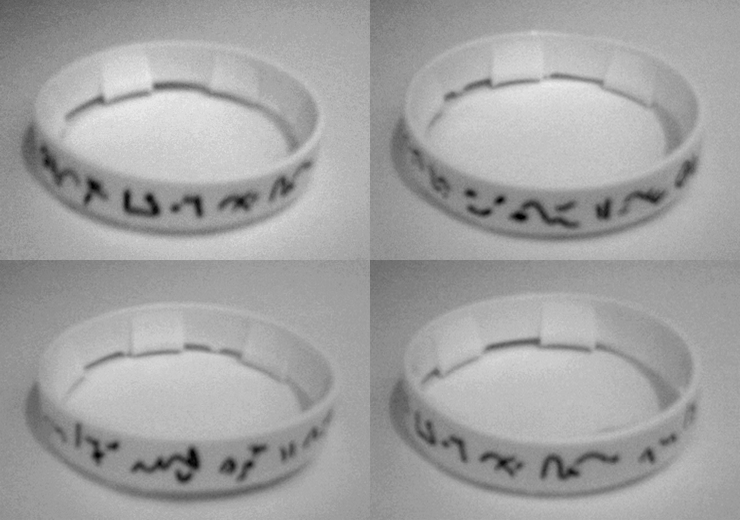
Luigi Di Cicco (see https://slowforward.net/2025/01/18/scritture-sul-ciglio-del-significato-luigi-di-cicco-2024-parte-prima/) reminds us that the term “scrittura asemantica” was coined by the Italian critic Gillo Dorfles in 1959 and it had (in the critic’s mind) the same meaning of the late 90s term “asemic”, coined by John Byrum and Jim Leftwich and spread by many artists, especially by Tim Gaze and Michael Jacobson.
In his study Dorfles was dealing with the art of Giuseppe Capogrossi (https://slowforward.net/2025/03/14/dorfles-capogrossi-1959/).
Dorfles used the term again in the following decades, for example in Le scritture asemantiche di Irma Blank, an essay he wrote for a 1974 art exhibit of Irma Blank. I published that text here: https://gammm.org/2007/07/18/blank-dorfles/ [English translation included].
In the same year(s), the artist Tomaso Binga (alias Bianca Menna) was working on her “scritture desemantizzate”: https://www.rivistasegno.eu/le-scritture-desemantizzate-di-tomaso-binga/.
My long essay (in Italian) about asemic writing is here: https://www.ikona.net/marco-giovenale-asemics-senso-senza-significato/ and it’s maybe still useful in exploring non-semantic / illegible / linguistically glitched forms of art, for example Arturo Martini’s book Contemplazione (1918), Henri Michaux’ Alphabet (1927), Paul Klee’s “Abstrakte Schrift” (1931), Isidore Isou’s “hypergraphies” (40s), Bruno Munari’s Scritture illeggibili di popoli sconosciuti (“Illegible Writings of Unknown Peoples”: after 1945), Christian Dotremont’s texts (1950), Brion Gysin’s Marrakesh (1955) and several other works by him; or 65 Maximiliana ou l’exercice illégal de l’astronomie by Max Ernst (1964) etc.
(Up to Luigi Serafini‘s masterpiece, Codex Seraphinianus, 1976-78, published by Franco Maria Ricci in 1981: https://www.francomariaricci.com/it/libri/codex-seraphinianus).
*
Addenda
Miekal And:
«F.W.H. Myers — a classicist who also coined “telepathy” — in 1885, in Automatic Writing II, in the “Proceedings of the Society for Psychical Research” used “asemia” and “asemic” in a medical sense, denoting a “defect in the power of giving signs,” and described a person producing illegible automatic writing as having “asemic troubles”. He even produced the stuff himself: in 1875 he scrawled rapidly many meaningless interlacing strokes that sometimes vaguely resembled letters but never formed a legible word — and considered these creations of no interest».
Actually, the doubts some people had in using the term “asemic”, at the beginning of our century, was due precisely to the medical meaning of the word. It seems to me that some dictionaries updated their lists & mentioned the other meaning, the ‘artistic’ one, only in 2017.
You can find Myer’s text here: https://archive.org/details/proceedingsofsoc03soci
*
more links:
– https://slowforward.net/2025/03/07/ricominciamenti-luigi-di-cicco-2025/
– https://slowforward.net/2025/01/18/enzo-patti-un-contributo-su-asemia-da-un-saggio-di-gillo-dorfles-unannotazione-di-luigi-di-cicco/
– https://slowforward.net/2024/12/31/luigi-di-cicco-capogrossi-dorfles-scrittura-asemantica/
– https://alfabetadue.it/2015/02/15/gioco-e-radar-05-asemic-writing/