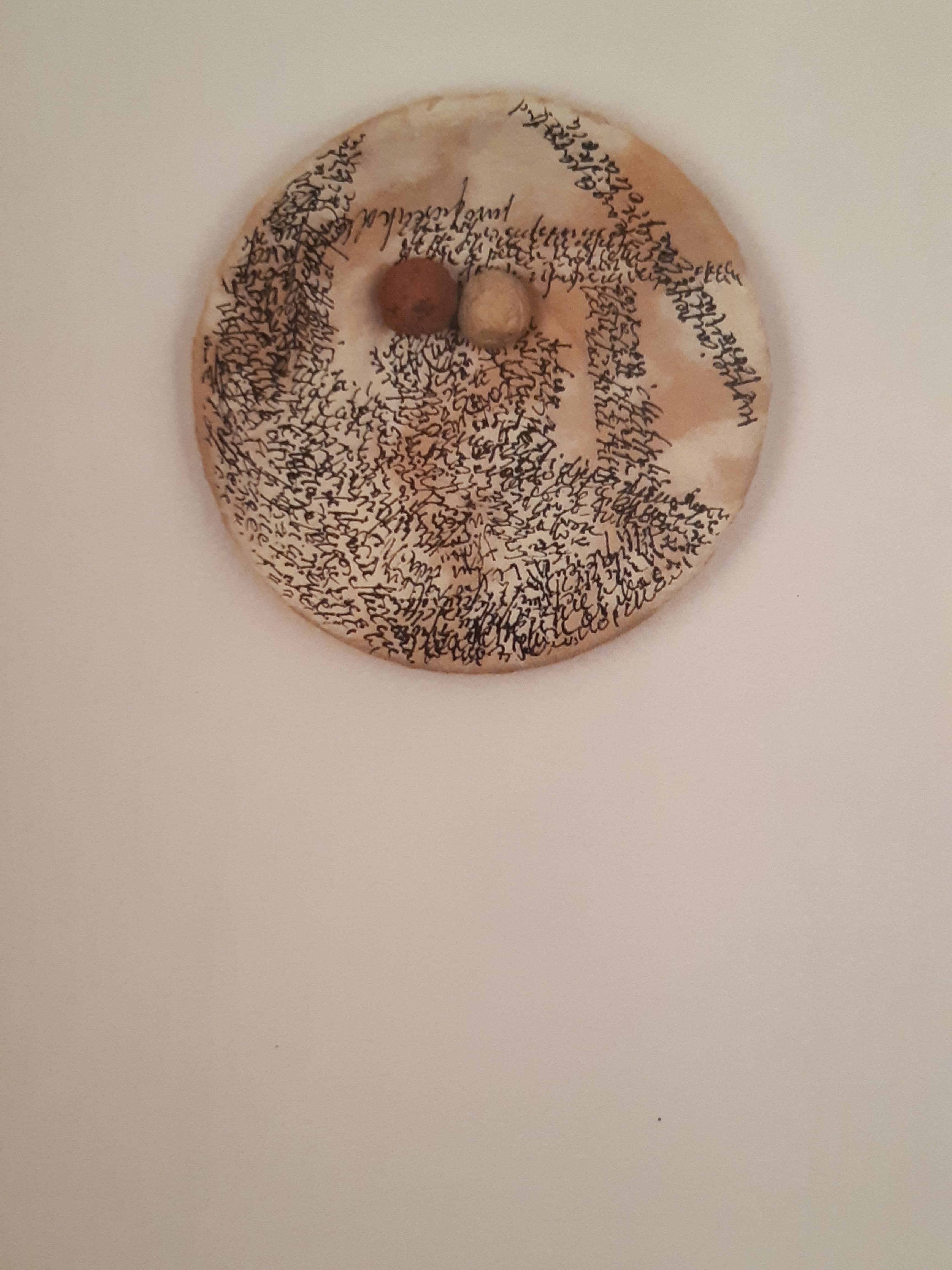
Corrado Costa, “Le bisbiglie bisbigliano” (1990)
in: Eugenio Gazzola (a c. di), “Corrado Costa. Le apparizioni dell’uomo invisibile” (Mazzotta, 2009, p. 59)

Corrado Costa, “Le bisbiglie bisbigliano” (1990)
in: Eugenio Gazzola (a c. di), “Corrado Costa. Le apparizioni dell’uomo invisibile” (Mazzotta, 2009, p. 59)
per un caso imprevedibile, la stampa di una serie di langrid da differx.tumblr.com si è rivelata caotica, con casuali sovrapposizioni di immagini. che tuttavia assai mi garbano. e le ripropongo qui. in foto minuscole e a bassa risoluzione, e nel pdf da cui sono tratte, anch’esso estremamente sgranato. ma: bene così.
https://slowforward.files.wordpress.com/2020/08/aleatory-superimposition-of-langrids-at-differx-tumblr-com.pdf
https://youtu.be/-ANoEonWhC0
I often drawrite “langrids”. A langrid is a grid of language.
I always had in mind Robert Smithson’s A heap of language (1966), or Paul Celan’s Sprachgitter (1959).
In my work, grids and squares and weird geometric shapes collide with pieces of superimposed sentences, asemic bits, other shapes, syllables.
Take a tour here:
https://differx.tumblr.com/search/langrid
or here: https://slowforward.net/?s=langrid&submit=Search
or here: https://tinyurl.com/y487l2eo
or here: https://the-otolith.blogspot.com/2014/07/marco-giovenale.html

A book about writing and its shadow side. It examines a number of practices, from the early 20th century to the present day, in which writing leaves behind its communicative function and moves toward the sphere of the illegible and unspeakable.
Writing by Drawing sets out to explore the tension inherent in script, the way it hovers between the genuinely semantic realm and the uncharted territory of mere arabesques, automatisms, repeated marks, and scribbles.
All of the works presented inhabit a special terrain vague in which the act of writing is more about “trying to say” than “saying” itself, more about potentialities of meaning than about signification. Such writing has transcended communication, becoming a trace of existence and affirmation of self but also an element of fancy, a metaphor for the mysterious weft of the world. Our investigation centers on this ancient human impulse to move past the communicative side of writing toward the unfettered, absolute reclamation of the mark, with its wealth of imaginative possibilities.
*
http://www.skira.net/en/books/scrivere-disegnando#
in French:
http://www.skira.net/en/books/scrivere-disegnando-1
https://www.instagram.com/p/CC6SLqaFH6M/
_
Il post del 1 luglio su Sloforward (https://slowforward.net/2020/07/01/landirivieni/) mi ha fatto venire in mente il testo a p.79 del libro Figurina enigmistica:
Visualizing data is like photography [6]
(Millivan e Sullivan si fanno un viaggio)ciò che veramente mi ha colpito, però, era sapere che le linee non rappresentano coste o fiumi o confini politici ma i veri rapporti umani dove sei? a casa sto arrivando qui dietro alle tue spalle dove sei? non c’è campo dove è andato? dove è adesso? non è raggiungibile Tolstoj il traffico è residuo avete lasciato la Slovenia e siete entrati in Croazia dovete andare a votare è ora di rivolgersi verso la Mecca per pregare
1941 Varsavia a occidente, 1809 Varsavia a oriente , XIV sec. non c’è Varsavia. Registrazioni: “Avete lasciato la Germania e siete entrati in Polonia” [7]
apt-get install anarchy
Sconnessione, scrivi, “in tanti tempi e frammenti di tempi”; “la perdita inevitabile e a volte radicale del contatto, oppure la ricomparsa di voci che si davano per disperse, la dissipazione della grana del discorso, il suo sgretolamento e resurrezione”, mi rende in modo magnifico la frammentazione della dimensione umana e la possibilità di un’autentica riconnessione. Via da schemi di pensiero, via dalle gabbie percettive, via dai cliché.
Penso che la questione difficile del “soggetto” possa essere affrontata proprio a partire dal discorso del glitch che pone in primo piano il disturbo della dimensione individuale dell’umano. L’umano che si pensa in quanto “individuo” è in realtà un essere diviso, scisso da un movimento del reale che lo comprende ma in cui non riesce, in ultima istanza, a sentirsi e a pensarsi.

One of my first flarfy & spam-derived “orphic tabs” (or “orphic sheets”) was published by the late William James Austin in 2007, in his mag “BLACKBOX”, Sept. 2007, the “summer collisions” issue.
About that issue I could only find an email in the Spidertangle newsletter, Sept. 16, 2007.
(The old link williamjamesaustin.com/orphicsheet002.html doesn’t work anymore, of course).
*
Other pieces appeared in Starfishpoetry, and Poetry Kessel-lo (two now offline sites).
Find others in The Flux I Share (Jan., 2008): ex fluxishare.blogspot.com/2008/01/orphic-tab-029.html now http://the-flux-i-share.blogspot.com/2008/01/orphic-tab-029.html; & in SayingSomething: http://sayingsome.blogspot.com/2008/01/orphic-tab-040.html
*
Then serious asemic orphic tabs appeared in The New Postliterate (Sept., 2009): http://thenewpostliterate.blogspot.com/2009/09/asemic-orphic-sheets-from-marco.html
A sheet in Italian has appeared in facebook only.
Here below are some of the pieces, and more ones (click to enlarge, read & enjoy):

from the asemic exhibit @ Brolo Art Space (Mogliano Veneto, June 2020)
.