IL BENE DI FUORI ORARIO Carmelo Bene…. “per prima cosa penso a vivere, poi vivo, la stessa cosa continua. Improvviso partendo da qualcosa di molto elaborato. Cerco di non scadere nel compiacimento. E’ l’unica libertà assoluta. Altrimenti c’è il delirio… I miti italiani non mi riguardano. La Vergine e i Vangeli li lascio a Pasolini” (intervista a Carmelo Bene di Jean Narboni 1968)
Da venerdì 18 marzo Fuori Orario cose (mai) viste dedica un ciclo all’opera di Carmelo Bene
FRANCIS BACON The First Pope Gagosian – Davies Street, London March 15–April 23, 2022
Gagosian is pleased to announce the exhibition of Francis Bacon’s first treatment of the papal image—a subject that would preoccupy the artist on and off for at least two decades. Executed circa 1946, this highly important picture in Bacon’s oeuvre has never before been exhibited publicly. The canvas entered a private collection in 1967 and was only rediscovered during the compilation of the artist’s catalogue raisonné by Martin Harrison, which was published in 2016. The painting will be on view in Gagosian’s Davies Street gallery from March 15 to April 23, 2022.
Scholar, art historian, and Gagosian director Richard Calvocoressi commented, “It is particularly exciting that this important early Bacon has reemerged now, while three of the artist’s reinterpretations of the Pope theme—from 1949, 1951, and 1965—are on display in London, in the Royal Academy’s current exhibition, Francis Bacon: Man and Beast.”
‘Landscape with Pope/Dictator’ (c. 1946) (the title is placed between quotation marks in the Bacon catalogue raisonné because the artist did not give it one) was painted in Monte Carlo, Monaco, where Bacon lived for much of the time from 1946 until 1950. Having survived the London Blitz and wartime austerity, he was susceptible to the Mediterranean climate, the good food, and the temptations of the casino. In Monte Carlo he completed only a handful of paintings, of which this is one. On October 19, 1946, he wrote to Duncan MacDonald, a director of the Lefevre Gallery in London: “I am working on three studies of Velasquez’s portrait of Innocent II [sic]. I have almost finished one. I find them exciting to do.”
A couple of months later, starved of the stimulating company of sympathetic fellow artists, Bacon wrote to his friend Graham Sutherland, hoping to persuade him and his wife Kathy to join him in Monte Carlo for the winter. “I don’t know how the copy of the Velasquez will turn out,” he added. “I have practically finished one I think. . . . it is thrilling to paint from a picture which really excites you.”
In 1946 Bacon would have known Velázquez’s full-length Portrait of Innocent X (Galleria Doria Pamphilj, Rome) only in black-and-white reproduction. From the following year he could have seen the half-length version at Apsley House, London, when a selection of the Duke of Wellington’s collection went on show, although the house itself did not open to the public until 1952. However, a number of Bacon’s radical reinterpretations of images of enthroned Popes in the 1950s were based not on Velázquez’s portraits of Innocent X but on photographs of a living Pope, Pius XII—a controversial pontiff owing to his alleged failure to publicly condemn Nazism and the Holocaust. In Bacon’s paintings he can be identified by, among other details, his metal frame spectacles.
Another source for the picture was Bacon’s fascination with press and propaganda photos of Fascist dictators and their henchmen. ‘Landscape with Pope/Dictator’ is one of a very small number of his paintings in which the attributes of a Catholic clergyman—for example, the traditional cap known as a biretta—are combined with the secular garb of the political leader, such as a suit or uniform, shirt, and tie. The microphone appears in other works of this period. Pius XII was sometimes photographed speaking in front of microphones, although entirely without the atmosphere of suggestibility, mass hysteria, and violence implied by the shouting or screaming mouth and strutting stance of the dictator.
The columns in the background of Bacon’s picture seem to have been based on a photograph of a neoclassical colonnade such as those found in public buildings by Albert Speer and other Nazi architects.
The fusion of human and animal in the Pope/Dictator’s blurred face and wide-open mouth with prominent teeth—a theme of the current Bacon exhibition at the Royal Academy, London—suggests that Bacon was already looking at photographs of monkeys and chimpanzees. Another arresting feature is the bank of delicately painted pink and green flowers, probably cyclamen, beneath the podium, which also evokes a crowd of waving or saluting hands. The predominant tonality of blue-violet anticipates the later series of Popes from 1951 and 1953.
Francis Bacon: Man and Beast is on view at the Royal Academy, London, through April 17, 2022.
SOLVENTI #2 è dedicato a Ferruccio De Filippi, agli anni della sua arte fra il 1970 e il 1974. È il risultato di conversazioni più o meno su: tempo archeologico, disseminazioni di calchi e nomi, posizione statica del corpo, simulacro, la lettura come atto non lineare, e qualcos’altro che riguarda la pittura, anche se non c’è la pittura.
Il volume si è composto a partire dalle foto di Mariella Bolzoni, che ha seguito da vicino la ricerca di Ferruccio, essendo complice più che testimone. Fondamentale è stata la cura sapiente del laboratorio Fotogramma24 (Bugionovi & Co.).
SOLVENTI è un progetto basato sulla collaborazione con Claudia Damiani e le edizioni Cambiaunavirgola – Spazioetico.
Il libro raccoglie documenti relativi alle opere realizzate da Ferruccio De Filippi nel periodo compreso tra il 1970 e il 1974, durante il quale la ricerca dell’artista si è sviluppata prevalentemente in dialogo con Gian Tomaso Liverani e la sua galleria La Salita. Fondamentale in quegli anni è l’incontro con Mario Diacono, al quale, dieci anni dopo, si deve la definizione della pittura di De Filippi come “reliquia del Linguaggio” e “risposta ‘politica’ alla messa in assenza del Linguaggio”.
Non sono ancora, quelli, gli anni della «pittura», e il Linguaggio (Diacono mette le virgolette alla pittura e la maiuscola al linguaggio) si esprime in modi e tecniche che vanno dalla fotografia al comportamento, in particolare attraverso l’uso ricorrente di testi di antropologia e mitografia all’interno dell’opera, non quindi come pura ispirazione, ma come vero e proprio fiato dell’opera.
The flicker effect was identified by the famously independent-minded scientist W. Grey Walter in his best- selling 1953 book The Living Brain.
Grey Walter – who was soon to become the father of Artificial Intelligence – discovered that by using high-powered stroboscopes and experimenting with trigger feedback techniques where the flash was set to fire in synchronization with the brain’s rhythms, the brain is, “transformed temporarily to a different sort of brain.” Walter found that time itself could become lost or disturbed. As he observed of one subject:
“[He had] the sense of having been pushed sideways in time by flicker. Yesterday was no longer behind, and tomorrow was no longer ahead..”
Stroboscopic light, or light flashing on the eye between 8 and 13 flashes per second, induces alpha wave activity in the brain – a state normally associated with dreaming and creativity. Subjects often report seeing shapes and colours, some have full-blown hallucinations, others mystical experiences. Approximately one in 4,000 people will have an epileptic seizure.
In 1997, ten million Japanese schoolchildren, and some adults, tuned into the animé cartoon Pokemon to see a “flashing explosion with high frequency red and blue flicker stimulation” hit the screen and persist. What happened next sparked international headlines. Some viewers went into a trance-like state, as if hypnotized. Others experienced altered vision and shortness of breath. Some passed out, others had seizures. Hospitals all over Japan received admissions, though nobody was permanently damaged.
20 anni senza Gilberto Centi, poeta, performer, agitatore culturale, con lui si è segnato un momento fondamentale della storia culturale bolognese e contemporanea
interventi di Vincenzo Bagnoli, Stefano Massari, Wu Ming 2, Antonio Bagnoli (Pendragon edizioni) Musiche di Cesare Ferioli (batteria) Marzio “Mars” Manni (chitarra)
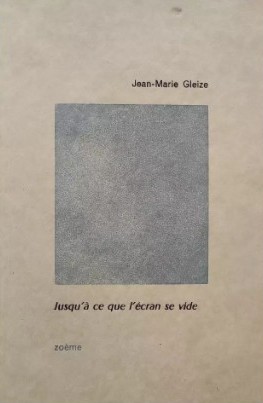
Jusqu’à ce que l’écran se vide est un travail plastique réalisé par Jean-Marie Gleize à partir de cibles de tir et de polaroids. Cette publication fait suite à une exposition qui s’est tenue dans la galerie de Zoème en 2021, et qui avait pour titre Les cibles. À l’occasion de cette exposition, Jean-Marie Gleize est revenu sur la genèse de ce projet : « C’est ainsi que ça commence. Dans un jardin à Aix. Il tirait sur des cibles. Il avait cloué ces cibles sur la branche d’un arbre. Je l’ai regardé viser, tirer. C’était comme un spasme nerveux, involontaire, une décharge sans raison, contre rien. J’ai ramassé ce qui restait, des traces au sol comme des feuilles tachées, trouées. Je les ai déchirées, les ai maculées d’encre rouge, et puis je les ai perdues. C’était au tout début des années 90. Et vers la même époque, aux États-Unis, en Californie et dans le Vermont, j’ai pratiqué intensément (de façon quasi pulsionnelle) la captation mécanique du réel, minimale, brutale, d’un réel simplement là : image sans contenu (comme les cibles), sans négatif, instantané unique sans copie ni retouche possibles, celle du Polaroïd. » Jusqu’à ce que l’écran se vide se compose de 30 polaroids, reproduites à l’échelle 1:1, et la reproduction de 14 cibles. Au centre, un poème inédit de Jean-Marie Gleize propose une autre variation autour du motif central de ce livre : le réel en tant qu’image sans contenu.
Si tratta di essere e di continuare a stare nella parte sbagliata: di essere nel retro, come non si è stancato di ripetere Corrado Costa: il retro della poesia, il retro del discorso, e continuare a sbagliare, a essere (« testoni e cocciuti ») nella parte sbagliata (il retro tace, non dice niente del discorso, è il retro).
It is about being on the wrong side, and staying there. It is about being on the B – side, as Corrado Costa loved to say: the B – side of poetry, the B – side of the discourse, and persisting in the error, « stubborn and pigheaded », always where you shouldn’t be (the flip side is silent, it adds nothing to the conversation, it’s the flip side).
181 scritture, disegni, grafie, materiali asemici di Marco Giovenale fuori testo, a colori e in b/n. Con introduzione e intervista (in italiano e inglese) all’autore a cura di Giuseppe Garrera. Traduzione di Johanna Bishop. 181 texts, drawings, glyphs, asemic works by Marco Giovenale, col. and b/w. Preface and interview: Giuseppe Garrera. Text: Italian and English (English translation: Johanna Bishop).
*
Esaurita la prima tiratura, è disponibile la ristampa dell’Enciclopedia asemica / Asemic Encyclopaedia (IkonaLíber, 2022)
n.b.: restano solo due copie disponibili della prima edizione. (a prezzo minore rispetto alla nuova). chi desiderasse acquistarle può scrivere all’editore:http://www.ikona.net/contatti/
For the launch of the The L=A=N=G=U=A=G=E Book in a French translation by Amélie Ducroux, the publisher, Presses Universitaires de Rouen et du Havre (PURH) has orgnizaed an events in Paris and the Université de Rouen.
Review of L=A=N=G=U=A=G=E, le livre by Emmanuel Laugier in Matricule des Anges (Dec. 2021) #228: pdf
Paris: Weds., March 23, 7:30pm (19h30)
POETES AMERICAINS de la mouvance l=a=n=g=u=a=g=e
at « l’ours et la vieille grille », 9 rue Larrey, Paris 75005, métro Monge ou Censier-Daubenton
Featuring Susan Bee, Amélie Ducroux, Sally Silvers, Bruce Andrews, Charles Bernstein and Christophe Lamiot Enos (invited by Paul de Brancion). Mostly bilingual.
Paris: Fri., March 25, 7:30pm (19h30), doors open 19h.
at the Red Wheelbarrow Bookstore, 11 Rue de Médicis, 75006 Andrews and Bernstein, with Lamiot Enos: English only
Rouen: Poésie, (é)motions: March 21, 2022
Université de Rouen, Mont-Saint-Aignan, Salle des Conférences / Maison de l’Université
Anne-Laure Tissut et Christophe Lamiot Enos (ERIAC)
9h30 : Ouverture de la journée : Anne-Lise Worms (Vice-Présidente du Conseil Académique), François Bessire (ancien Directeur des Presses Universitaires de Rouen et du Havre)
I9h45-10h: Introduction — Christophe Lamiot Enos (ERIAC, Université de Rouen)
10h-10h30 : lectures—Bruce Andrews
10h30-11h : table ronde, avec Bruce Andrews, Susan Bee, Charles Bernstein, Amélie Ducroux, Isabelle Garron, Sally Silvers, modérateurs Christophe Lamiot Enos et Anne-Laure Tissut, la revue L=A=N=G=U=A=G=E à la fin du XXème siècle (émergence, ambitions, réceptions, représentations), aux USA, en poésie et ailleurs
1h00-11h30 : discussion et pause café
11h30-12h : intervention—Susan Bee
12h-14h30 : discussion et pause déjeuner
14h30-15h30 : interventions—Sally Silvers, Charles Bernstein
16h-17h : table ronde, tous les participants, avec plus particulièrement Isabelle Garron, modérateurs Christophe Lamiot Enos et Anne-Laure Tissut, la revue L=A=N=G=U=A=G=E aujourd’hui, aux USA, en France, en poésie et ailleurs : enseignements, embranchements, jeunes pousses, avenirs, au regard du Nouveau monde, anthologie des poésies en France de 1960 à 2010.
L=A=N=G=U=A=G=E, le livreis part of the TO series, edited by Lamiot. This series includes blingual collections, not otherwise published in English, by Hank Lazer, Norman Fischer, ALice Notley, Roger Kamenetz, Joe Ross, Laynie Brown, Lee Ann Brown, and others, as well as manifestoes by Lamiot.
& just before the L=A=N=G=U=A=G=E Book launch Marseille
Charles Bernstein (with Martin Richet) at Le Centre international de poésie Marseille 6:30pm (18h30), Thurs., March 17, 2022 (bilingual) and earlier that day Susan Bee and Bernstein: worskhop on collaboration
Presentazione di “Prosa in prosa” (Le Lettere, collana fuoriformato, Firenze 2009), a cura di ESCargot, 16 febbraio 2010.
Il primo video è di Vincenzo Ostuni, il secondo di Sergio Garufi.
Su YouTube tutti i dettagli e i dati.
*
La ristampa TIC 2020 di Prosa in prosa, con grafica di Enrico Pantani e interventi critici di Paolo Giovannetti e Gian Luca Picconi, è disponibile qui: https://ticedizioni.com/products/prosa-in-prosa