
Archivi autore: differx
a sanremo, italo calvino: spazio paesaggio ambiente
Convegno internazionale
Italo Calvino.
Spazi paesaggio ambiente
Sanremo, 17-19 novembre 2022
Teatro dell’Opera del Casinò

un ricordo di pio monti

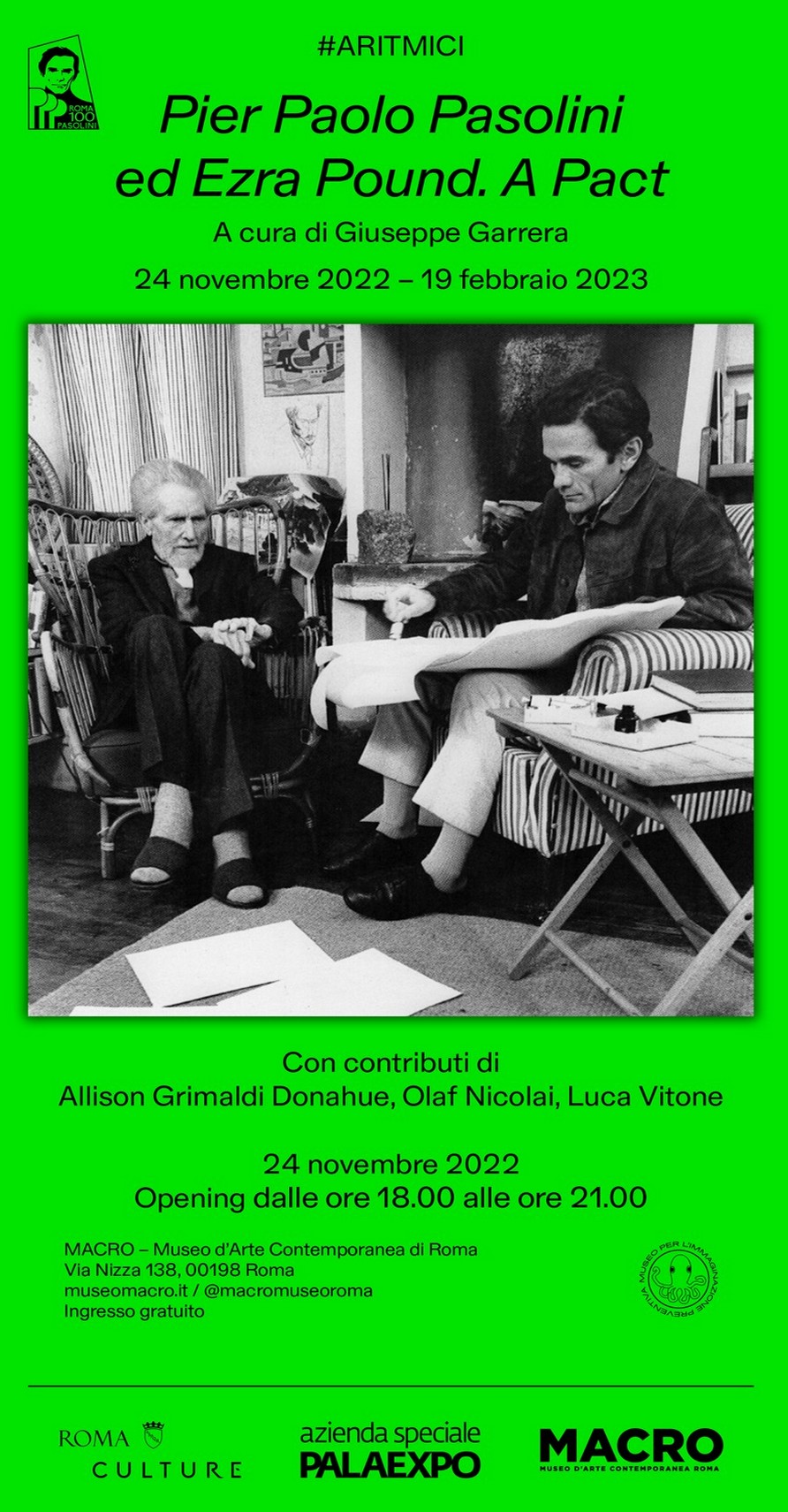
roma, 24 novembre, al macro in via nizza: pasolini+pound
Giovedì 24 novembre, alle ore 18, opening della mostra Pier Paolo Pasolini ed Ezra Pound. A Pact, a cura di Giuseppe Garrera, con contributi di Allison Grimaldi Donahue, Olaf Nicolai e Luca Vitone nella sezione ARITMICI del MACRO – Museo d’Arte Contemporanea di Roma, via Nizza 138. Pier Paolo Pasolini ed Ezra Pound. A Pact è legata al percorso della mostra Pier Paolo Pasolini. Tutto è santo – Il corpo poetico al Palazzo delle Esposizioni ed è promossa da Roma Culture e da Azienda Speciale Palaexpo nel programma PPP100 – Roma Racconta Pasolini.
cliccare per ingrandire
La stessa sera inaugurerà Robert Smithson, Rome is still falling nella sezione PALESTRA del museo e saranno presentate le opere Figura che divora se stessa (2021) di Giulia Cenci e Camouflage Milieux (2022) di Jim C. Nedd in Retrofuturo. Appunti per una collezione.
poesia macerata / differx. 2022
ancora sul romanticismo
il canto d’amore di j. alfred prufrock / t. s. eliot — — visage / luciano berio
Nel 1967 Nico D’Alessandria realizza un mediometraggio marcatamente sperimentale dal titolo Il canto d’amore di J. Alfred Prufrock, nel quale delle immagini scorrono deviate, accompagnate dalla recitazione della poesia di Eliot e da suoni distorti. La voce narrante è di Carmelo Bene, le musiche di Luciano Berio (Visage).
Titolari del copyright Kontor New Media Music Per conto di: col legno
Copyright © Visage (1961) [Remastered] Luciano Berio & Institute for Computer.
21 novembre, “echo / eco” @ campo boario: locandina

spread the word
“riga” per i cento del manga

cliccare per ingrandire
https://www.quodlibet.it/libro/9788822908971
“Oggi è il mio centenario; più esattamente, uno dei miei centenari”: così annuncia Manganelli su uno dei tanti giornali con cui collabora alla fine del 1980, proponendo di istituire il rito a rovescio della “scommemorazione”: sicché il 1880, per esempio, andrebbe celebrato quale “42° preanniversario della sua nascita”. Per festeggiare in modo adeguato il centenario della sua nascita (15 novembre 1922), ripresentiamo qui in forma completamente rifatta, e per tre quarti inedita, il volume di “Riga” uscito nel 2006, facendo tesoro di scoperte e ritrovamenti di suoi testi. Manganelli è un autore che pubblica più da morto che da vivo ed è diventato, nonostante tutto e come voleva Calvino, uno dei più acuti “interpreti del nostro tempo”. La spina dorsale del volume, insieme agli inediti (gli Appunti critici risalenti all’“archeologia” del ’48-56 e le trascrizioni delle conferenze per il Movimento di Collaborazione Civica), è costituita dall’ampia antologia della critica, con scoperte e ritrovamenti che coprono il periodo dell’attività in vita ma anche la ricezione dei suoi libri postumi: un materiale davvero significativo per capire cosa ha contato, e cosa conta ancora oggi, questo irregolare delle nostre lettere. Ben consci che Manganelli col suo sarcasmo i centenari li snobbava: “io punto ai millenari, s’intende uno ogni anno”.
charles bernstein a roma: 23 novembre, centro studi americani, “after l=a=n=g=u=a=g=e”

click to enlarge / cliccare per ingrandire
_evento facebook: https://www.facebook.com/events/538867828145311/
*
Charles Bernstein (New York, 1950) poeta e saggista statunitense, fondatore e redattore con Bruce Andrews della rivista «L=A=N=G=U=A=G=E» (1978-81) e esponente di punta dei Language poets, ha insegnato alla State University of New York a Buffalo e alla University of Pennsylvania, dove è stato professore emerito in inglese e letteratura comparata. È co-fondatore e co-curatore, assieme ad Al Filreis, di PennSound (writing.upenn.edu/pennsound) e curatore e co-fondatore, con Loss Pequeño Glazier, di The Electronic Poetry Center (writing.upenn.edu/epc). Tra i libri più recenti: Topsy-Turvy (2021), Near/Miss (2018), Pitch of Poetry (2016), Recalculating (2013), Attack of the Difficult Poems: Essays and Inventions (2011), All the Whiskey in Heaven: Selected Poems (2010).
giorgio manganelli moltiplicato: novembre e dicembre (inizio di)

cliccare per ingrandire
Mercoledì 16 novembre, h 18:30, Roma, libreria ELI, Viale Somalia 50A
STRONCATURE GIUDIZIOSE
con Massimo Barone, Marita Bartolazzi, Fabio Ciriachi, Paolo Morelli e Giorgio Patrizi

cliccare per ingrandire
Domenica 20 novembre, h 18:00, Milano, Castello Sforzesco, Sala Weil Weiss
IL LETTORE SUPREMO. MANGANELLI DA ZERO A CENTO
con Mariarosa Bricchi, Lietta Manganelli e Salvatore Silvano Nigro.
Letture di Paolo Bessegato. Conduce Andrea Cortellessa

cliccare per ingrandire
Martedì 22 novembre, h 18:00, Berlino,
Istituto Italiano di Cultura
MANGANELLI DIVISO A BERLINO
con Lietta Manganelli, Giovanni Sampaolo e Andrea Cortellessa. Letture di Carlo Loiudice. Conduce Maria Carolina Foi

cliccare per ingrandire
Mercoledì 23 novembre, h. 9-11, Università di Bologna, Aula Pascoli, via Zamboni 32,
per il centenario di Manganelli:
“A BOLOGNA SI MANGIA MALE”
Intervengono Marco Antonio Bazzocchi, Andrea Cortellessa, Luigi Weber.
Conclude Lietta Manganelli
inoltre:
Lunedì 28 e martedì 29 novembre, Università di Pavia, aula Foscoliana
IRRADIAZIONI. GIORGIO MANGANELLI E LA NEOAVANGUARDIA NEL MEDIUM
RADIOFONICO
convegno a cura di Federico Francucci con Lietta Manganelli, Roberta
Carlotto, Luca Scarlini, Gilda Policastro, Nicola Turi, Cecilia Bello
Minciacchi, Federico Francucci, Graziella Pulce, Federico Milone,
Rodolfo Sacchettini, Chiara Portesine, Giovanna Lo Monaco. Prima
nazionale del podcast *Amore* con Elvira Frosini e Daniele Timpano
Giovedì 1 e venerdì 2 dicembre, Napoli, RIOT studio e Università
Biblioteca Brau
LE FORME DELLA VOCE. MANGANELLI, BENE E L’IMMAGINAZIONE ACUSTICA IN
ITALIA
convegno a cura di Giancarlo Alfano con Andrea Cortellessa, Sara
Nocerino, Fabrizio Bondi, Arianna Agudo, Carmen Gallo, Giancarlo
Alfano, Paolo Giovannetti, Valentina Panarella, Giuseppe Andrea
Liberti, Lorenzo Morviducci, Riccardo Donati
21 novembre, charles bernstein a roma: presentazione di “echo / eco” allo studio campo boario
A Roma, lunedì 21 novembre, alle ore 18:00,
presso lo Studio Campo Boario
(viale del Campo Boario 4a), nel
contesto della rassegna Libridine2022,
presentazione del libro
ECO / ECHO
di Charles Bernstein
(Edizioni del verri, 2022)
Intervengono, insieme all’autore:
Barbara Anceschi, Carla Buranello,
Cristina Giorcelli, Marco Giovenale
Evento facebook: https://www.facebook.com/events/5600414610004641
Reading bilingue in italiano e in inglese. Interventi critici in italiano

ECO /ECHO
https://www.ilverri.it/index.php/le-collane/in-evidenza/eco-echo-detail
Traduzioni di
Luigi Ballerini, Gherardo Bortolotti, Carla Buranello, Marco Giovenale, Milli Graffi
Eco/Echo raccoglie le poesie scelte dall’autore a partire da Senses of Responsibility del 1979 fino agli ultimi testi usciti quest’anno negli Stati Uniti in Topsy-Turvy.
Ma non è un’antologia con testo a fronte. È un libro bifronte: da una parte i testi in inglese, dall’altra, capovolto il volume, le traduzioni curate dai poeti italiani che hanno collaborato con Bernstein nel segno di una poesia sperimentale e d’invenzione. Il volume accoglie inoltre un saggio di Bernstein sui rapporti tra poesia americana contemporanea e poesia italiana.
Per Bernstein la eco/echo-poetica è pensare alla scrittura come forma di ascolto verso una “risonanza non lineare di un motivo che rimbalza su un altro. Ancora di più, è la sensazione di allusione in assenza di allusione. In altre parole, l’eco che sto cercando – è lo stesso Bernstein a dircelo – è uno spazio vuoto: l’ombra di una fonte assente”.
*
Charles Bernstein (New York, 1950) poeta e saggista statunitense, fondatore e redattore con Bruce Andrews della rivista «L=A=N=G=U=A=G=E» (1978-81) e esponente di punta dei Language poets, ha insegnato alla State University of New York a Buffalo e alla University of Pennsylvania, dove è stato professore emerito in inglese e letteratura comparata. È co-fondatore e co-curatore, assieme ad Al Filreis, di PennSound (writing.upenn.edu/pennsound) e curatore e co-fondatore, con Loss Pequeño Glazier, di The Electronic Poetry Center (writing.upenn.edu/epc). Tra i libri più recenti: Topsy-Turvy (2021), Near/Miss (2018), Pitch of Poetry (2016), Recalculating (2013), Attack of the Difficult Poems: Essays and Inventions (2011), All the Whiskey in Heaven: Selected Poems (2010).
“statue linee”: in uscita
glossa volume 2
STATUE LINEE, di Marco Giovenale
In uscita il 18 novembre 2022 www.piedimoscaedizioni.com
«Piccole statue testuali sfuggono in linee e diramazioni. Friabili, gesso. Prose contrarie al gigantismo e alla permanenza si assottigliano fino al paradosso, giocano con doppie negazioni, passaggi deviati, finte, colpi di scena.
E se i materiali sono del tutto concreti, come mosche, latte, scalinate, uova, scarpe, basiliche, bic, neoprene, stetson, scorpioni, pepe e pernod, tutto può smaterializzarsi da una frase all’altra. Svolte di sintassi sono svolte dello sguardo: e quel che prima era materia, utensileria muji, visibile, diventa appena un’allegoria.»

Cos’è glossa?
Glossa, collana a cura di Carlo Sperduti si occupa di prose brevissime, con un’attenzione particolare alla sperimentazione e alla scrittura pura e una vocazione all’eterogeneità.
Glossa sceglie la forma brevissima in quanto campo privilegiato di ricerca, sospensione, deragliamento, mistero, esattezza, stile, densità, spostamento.
Glossa nasce dalla convinzione che non esista una definizione di letteratura ma che le sue definizioni siano, al contrario, potenzialmente infinite: vorrebbe contenerle tutte, ne propone alcune, le mette tutte in discussione.