
Archivi tag: arte
roma, 24 novembre, al macro in via nizza: pasolini+pound
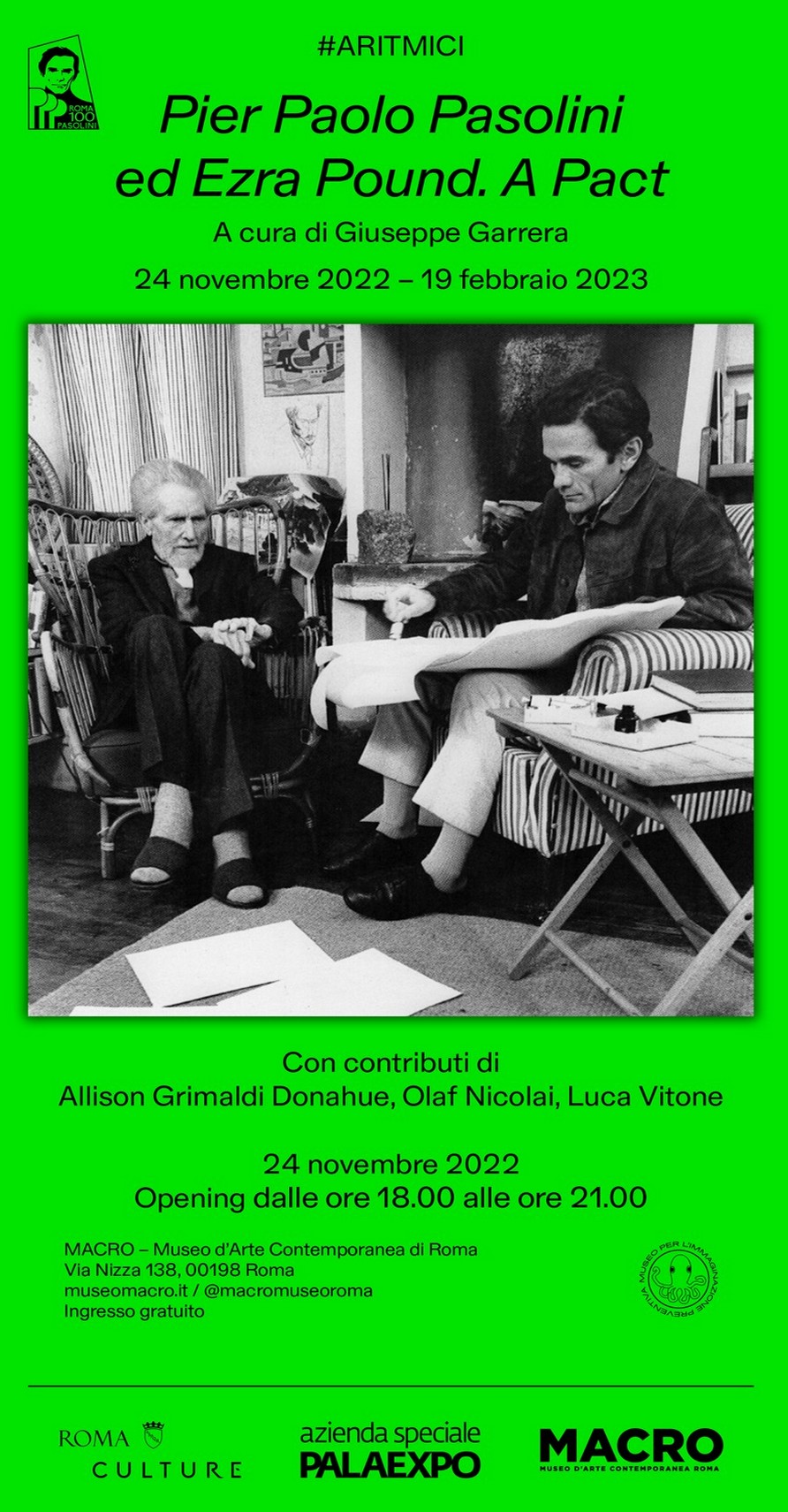
Giovedì 24 novembre, alle ore 18, opening della mostra Pier Paolo Pasolini ed Ezra Pound. A Pact, a cura di Giuseppe Garrera, con contributi di Allison Grimaldi Donahue, Olaf Nicolai e Luca Vitone nella sezione ARITMICI del MACRO – Museo d’Arte Contemporanea di Roma, via Nizza 138. Pier Paolo Pasolini ed Ezra Pound. A Pact è legata al percorso della mostra Pier Paolo Pasolini. Tutto è santo – Il corpo poetico al Palazzo delle Esposizioni ed è promossa da Roma Culture e da Azienda Speciale Palaexpo nel programma PPP100 – Roma Racconta Pasolini.
cliccare per ingrandire
La stessa sera inaugurerà Robert Smithson, Rome is still falling nella sezione PALESTRA del museo e saranno presentate le opere Figura che divora se stessa (2021) di Giulia Cenci e Camouflage Milieux (2022) di Jim C. Nedd in Retrofuturo. Appunti per una collezione.
il video di “ontologia dell’arte all’acqua di rose”, di alberto d’amico
luigi bonfante su duchamp, “fountain”
Gli elementi della rivoluzione duchampiana che portano alla realizzazione sia del Grande Vetro che dei readymade sono dunque gli stessi: il rifiuto della pittura, che è fatta con l’occhio e la mano, l’innovazione radicale, lo humour e l’ironia, l’indifferenza estetica, il gioco di parole, il caso. E tutti puntano verso una stessa direzione, paradossale per un artista: mettere in dubbio l’arte; o meglio, «farla finita con l’arte», «privare l’artista della sua aura», «sminuire il suo status all’interno della società». «La parola arte significa fabbricare, fare con le mani […]. Anziché farla, io la ottengo già fatta. […] è un modo per negare la possibilità di definire l’arte.»
L’Orinatoio vuole dunque rendere impossibile definire l’arte. E lo fa mettendo in cortocircuito l’utopia della libertà assoluta d’innovazione: se si elimina qualunque autorità estetica con il motto “niente giuria, niente premi”, s’impedisce sì, nel modo più drastico, che il passato limiti la libertà creativa, ma si legittima anche l’idea che chiunque possa essere artista e qualunque cosa egli proponga possa essere “opera”. Negli anni sessanta l’eredità di Fountain produrrà anche slogan come quello del movimento Fluxus “Tutto è arte e chiunque la può fare”, che troverà forti risonanze nello spirito di quel tempo e in molte esperienze artistiche coeve. Per esempio in Joseph Beuys, che criticherà Duchamp per aver abbandonato l’arte senza aver tratto la logica conclusione del suo gesto, cioè che «ogni essere umano è un artista».
Ma Duchamp era un dandy ironico e un individualista radicale, estimatore dell’Unico di Stirner. Basta pensare al Grande Vetro per capire che la sua produzione, così esoterica, enigmatica e sfuggente, ha ben poco a che fare con l’utopia di Beuys. Del resto, lo dirà esplicitamente: «L’individuo artista esiste, è esistito ed esisterà sempre, ma in quantità molto ristrette».
Anche se la rivoluzione di Duchamp (come quella di molte avanguardie del Novecento a partire dal Dadaismo) ha come conseguenza il dissolvimento del confine tra arte e vita, con Fountain egli non vuol dimostrare che tutto è arte e che quindi tutti possono essere artisti. Il suo primo, evidente intento è la dissacrazione dell’arte, di quell’arte che riteneva troppo “retinica” e troppo legata alla figura demiurgica dell’artista e al gusto. Il gusto è un’abitudine, diceva: «Se si ripete più volte qualcosa, si trasforma in gusto». Per questo si era messo a fare cose che sarebbe stato impossibile o assai difficile rinchiudere in qualche abitudine di pensiero, in qualche significato prestabilito. L’Orinatoio è l’esito più esplicito, caustico e ironico di questa dissacrazione dell’arte. Una dissacrazione che non corrisponde però all’antiarte del Dadaismo, perché l’antiartista, per Duchamp, è come un ateo: crede in negativo. Invece lui è uno scettico ironico, una mente cartesiana e corrosiva che dubita di tutto e non prende niente sul serio, a cominciare dall’arte stessa, che non vuole distruggere, ma appunto dissacrare: toglierle l’aura di superiorità, il carisma spirituale. Per questo ama definirsi “anartista”. A questo punto è evidente che l’opera più influente del Novecento non è un’opera d’arte, innanzitutto perché non rientra nel significato di “arte” elaborato dalla nostra cultura, per il quale bellezza ed emozione estetica sono concetti essenziali. Invece di suscitare emozione estetica, Fountain stimola domande di tipo filosofico: cosa fa di un oggetto un’opera d’arte? È davvero indispensabile che siano la mano, l’occhio e il gusto soggettivo dell’artista? Non potrebbe essere semplicemente il gesto mentale di scegliere qualcosa? (In fondo anche i tubetti di colore, arriverà a dire Duchamp, sono dei readymade scelti dal pittore.) In questo senso, anche se ironia, paradosso e ambiguità rendono inafferrabile il gesto di liberazione del readymade, si potrebbe dire che Fountain non è un’opera d’arte perché è un’opera sull’arte, un oggetto che stimola riflessioni sulla natura e il senso dell’arte stessa.
Luigi Bonfante CATASTROFE UNO. Duchamp e la spora aliena. Fountain, 1917-1963, in Catastrofi d’arte. Storie di opere che hanno diviso il Novecento, Johan & Levi editore, 2019
mirella bentivoglio: “simbolo come struttura 1984/2022” – @ tralevolte, roma, dal 7 novembre
MirellaXcento
Mirella Bentivoglio: simbolo come struttura 1984/2022
Dall’archivio fotografico di Corinto Marianelli
a cura di Manuela De Leonardis
inaugurazione @
associazione TRAleVOLTE
piazza di Porta San Giovanni 10
lunedì 7 novembre, alle ore 18:00

cliccare per ingrandire
La mostra sarà visibile fino al 25 novembre 2022 ore 17-20 dal lunedì al venerdì
http://www.tralevolte.org
Comunicato stampa completo: qui
_
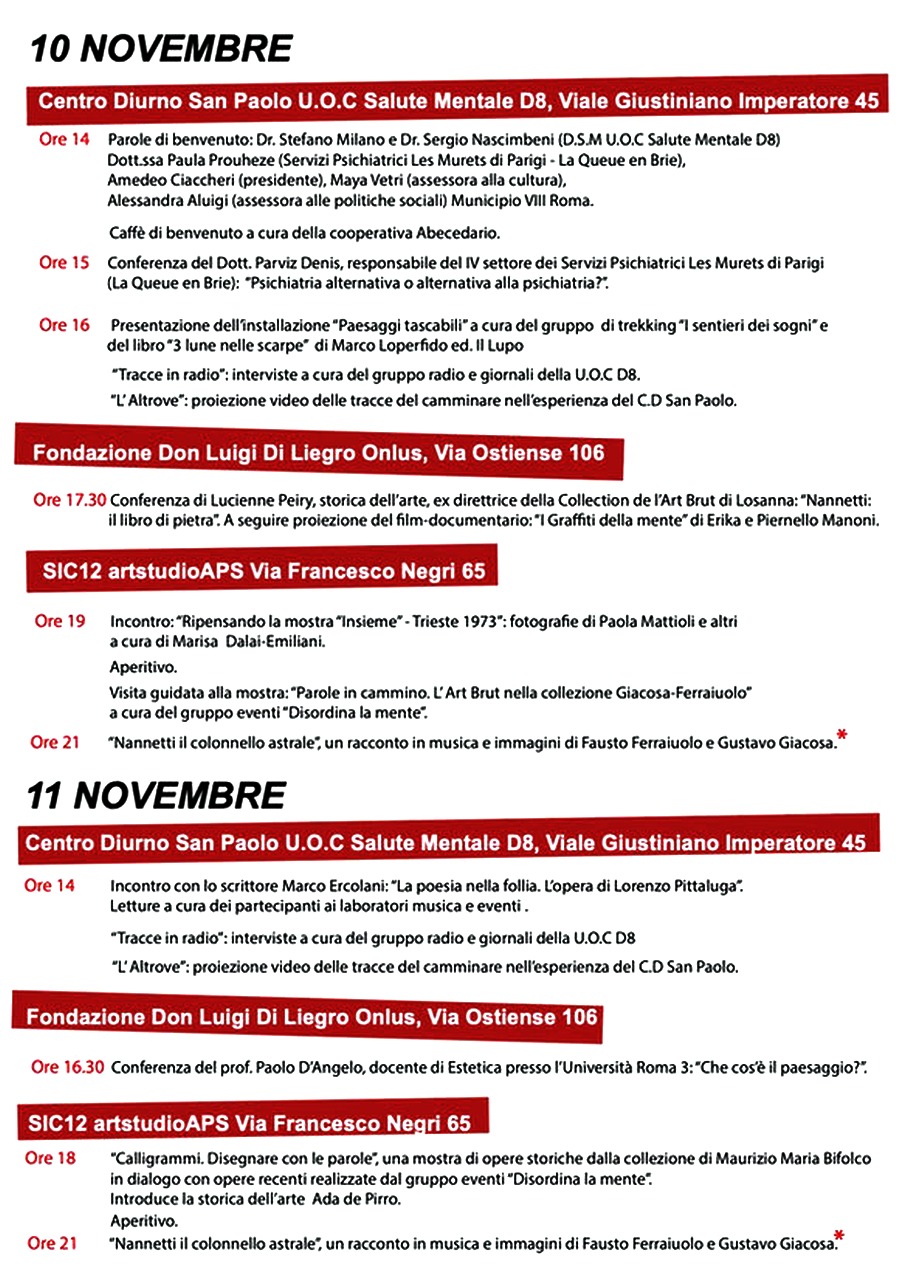
roma, 10-11-12 novembre, festival tracce #1 : arte+alterità+altrove
Dal desiderio di interrogare artisticamente la nozione sempre fertile e fluttuante di follia, SIC12artstudio, in collaborazione con ASL Roma 2 e il Municipio VIII
presenta
Festival TRACCE#1
ARTE+ALTERITA’+ALTROVE
cliccare per ingrandire

cliccare per ingrandire
“erasing to unveil”: emilio isgrò a parigi, tornabuoni arte

“perlepie”, di gian domenico sozzi @ studio stefania miscetti, 10 novembre 2022
STUDIO STEFANIA MISCETTI annuncia l’esposizione personale di
GIAN DOMENICO SOZZI
perlepie
inaugurazione: giovedì 10 novembre 2022, dalle 18 alle 21
in via delle Mantellate 14 – Roma
chiusura: gennaio 2023
orari: da martedì a sabato, dalle 16 alle 20

STUDIO STEFANIA MISCETTI è lieto di presentare perlepie, sesta esposizione personale di Gian Domenico Sozzi presso gli spazi della Galleria.
Le opere in mostra, tutte prodotte quest’anno ed in gran parte inedite, costituiscono una serie di serigrafie su specchio tutte realizzate a partire da antichi dipinti in rovina. Continua a leggere
6 novembre: finissage “monochromacolor” + proiezione “ontologia dell’arte all’acqua di rose”
Domenica 6 novembre, allo Studio Campo Boario (viale Campo Boario 4a), finissage della mostra Monochromacolor e doppia proiezione, alle 18:30 e alle 20:00 di Ontologia dell’arte all’acqua di rose

otoliths, issue #67
Issue sixty-seven of Otoliths, the southern spring, 2022 issue, is now live.
A little bit larger than normal, it contains the usual wide variety of work, this time from Judith Skillman, Elisa C. Martínez Salazar, Cecelia Chapman & Jeff Crouch, Paul Siegell, Michael Orr & Texas Fontanella, Peter Yovu, Anna Cates, Sanjeev Sethi, Kyle Hemmings, Riccardo Benzina, Steven Bruce, CL Bledsoe, Texas Fontanella, Alan Catlin, David Miller, Craig Cotter, Ali Zarbali, Sharon H. Frost, Dale Jensen, Eric Hoffman, Lynn Strongin, Karl Kempton, Paul Dickey, Jack Galmitz, Gao An, Stacey Allam & John M. Bennett, John M. Bennett, Ioan Bunus & John M. Bennett, Bob Kotyk, Michael J. Leach, petro c. k., Maria Giesbrecht, Richard Kostelanetz, Demosthenes Agrafiotis, KJ Hannah Greenberg, Grzegorz Wróblewski, Jimmy Crouse, Nathan Anderson, Daniel de Culla, John Geraets, Jennifer Weigel, Judith Roitman, Ivars Balkits, Rob Martelli, Tohm Bakelas, Elaine Woo, Michael Sikkema, Livio Farallo, Diana Magallón, Jim Meirose, Carol Stetser, Eric Lunde, Sheila E. Murphy, dan raphael, Richard Magahiz, Daniel Barbiero, Pawel Markiewicz, Lawrence R. Smith, Mike Callaghan, John Tustin, George Myers Jr., Mark Pirie, James Grabill, Caleb Puckett, Damon Hubbs, Tim Gaze, Marilyn R. Rosenberg & Ann R. Shapiro, Mark Danowsky, Piet Nieuwland, Christopher Barnes, Guy R. Beining, Harvey Huddleston, Sterling Warner, Pete Spence, Julia Vaughan, Lewis LaCook, Dave Read, Susan Gangel & Ken Hay, Benjamin Niespodziany, Jim Leftwich, Joanne Bechtel, Brooks Lampe, Olchar E. Lindsann, John Digby & Bill Wolak, Linda M. Walker, Maximilian Speicher, Lucia Sapienza, LUNE OFFLINE, Samarra Prahlad, Gavin Lucky, Tom Beckett, Jeff Harrison, Bill Wolak, James Yeary, Joshua Martin, Uvia Shcho, Antonio Devicienti, Mark Cunningham, Carla Bertola, Alberto Vitacchio & Carla Bertola, Mercedes Webb-Pullman, Edward Kulemin, Nicholas Alexander Hayes, harry k stammer, Kenneth Rexroth, Jeff Bagato, Nathan Whiting, Catherine Eaton Skinner, Eileen R. Tabios, Mark Yale Harris, Heath Brougher, Natalie Christensen, Vernon Frazer, Bob Lucky, Daniel f Bradley, Heather M. Browne, Marcia Arrieta, Patrick Sweeney, John Levy, Glenn Ingersoll, Michael Ruby, Hrishikesh Srinivas, J.I. Kleinberg, Kit Kennedy, Caleb Fenez, Keith Nunes, Marilyn Stablein, Cecelia Chapman, M.J. Iuppa, Daniel Lehan, Elmedin Kadric, Hubert Kretschmer & Jürgen O. Olbrich, Penelope Weiss, Siân Vate, Elena Zalogina, Jill Jones, Alan Peat & Réka Nyitrai, Réka Nyitrai, hiromi suzuki, Thomas Camus, Barnaby Smith, J. D. Nelson, K. Roberts, Dennis Andrew S. Aguinaldo, Peter Cherches, Cherie Hunter Day, Keith Higginbotham, Angelo ‘NGE’ Colella, Darrell Petska, David Jalajel, Paul Pfleuger, Jr., & Jim Leftwich & John M. Bennett.
“manipulating light can induce psychedelic experiences – and scientists aren’t quite sure why”
theconversation.co &
uk.news.yahoo:


From Jan E. Purkinje’s documentation of the subjective visual phenomena he saw when he waved his hand in front of his closed eyes. Author provided: see https://uk.news.yahoo.com/manipulating-light-induce-psychedelic-experiences-090946328.html
read the post here:
https://theconversation.com/manipulating-light-can-induce-psychedelic-experiences-and-scientists-arent-quite-sure-why-192885
& here:
https://uk.news.yahoo.com/manipulating-light-induce-psychedelic-experiences-090946328.html
_
keith haring a monza

Tra le opere in esposizione, la serie Apocalypse, realizzata con William Burroughs.
_