Archivi categoria: kritik

lals: intervista a gammm

tutto quello che avreste sempre voluto sapere su gammm.org e non avete mai osato chiedere:

#scritturadiricerca #installazione #googlism #flarf #traduzioni #testiinstallativi #experimentalwriting #GAMMM #ricercaletteraria #cambiodiparadigma #chapbooks #LALS

tic talk di giugno: il calendario

calendario tic talk giugno 2021

31 maggio, presentazione di: corrado costa, “poesie edite e inedite (1947-1991)”

Lunedì 31 Maggio, alle ore 21:15

per Bologna in Lettere 2021 – il Festival online
in diretta sui canali del Festival e di Argo – Rivista e Casa editrice

Presentazione del volume:

Corrado Costa

Poesie edite e inedite (1947-1991)

Opere poetiche II  

*

Interverranno: Chiara Portesine, Giovanni Fontana, Marco Berisso, Andrea Inglese

Introduce Enzo Campi – Modera l’incontro Roberta Bisogno

Canali:
https://www.youtube.com/channel/UCwbyJs4m8bYnn8OuqpX3riA
e https://www.youtube.com/channel/UCc7ll3RnO6cyBq6Er8NtzYw

Evento facebook:
facebook.com/events/314899083493251

Info sul volume:
https://www.argonline.it/prodotto/corrado-costa-poesie-edite-e-inedite-1947-1991-opere-poetiche-ii/

_

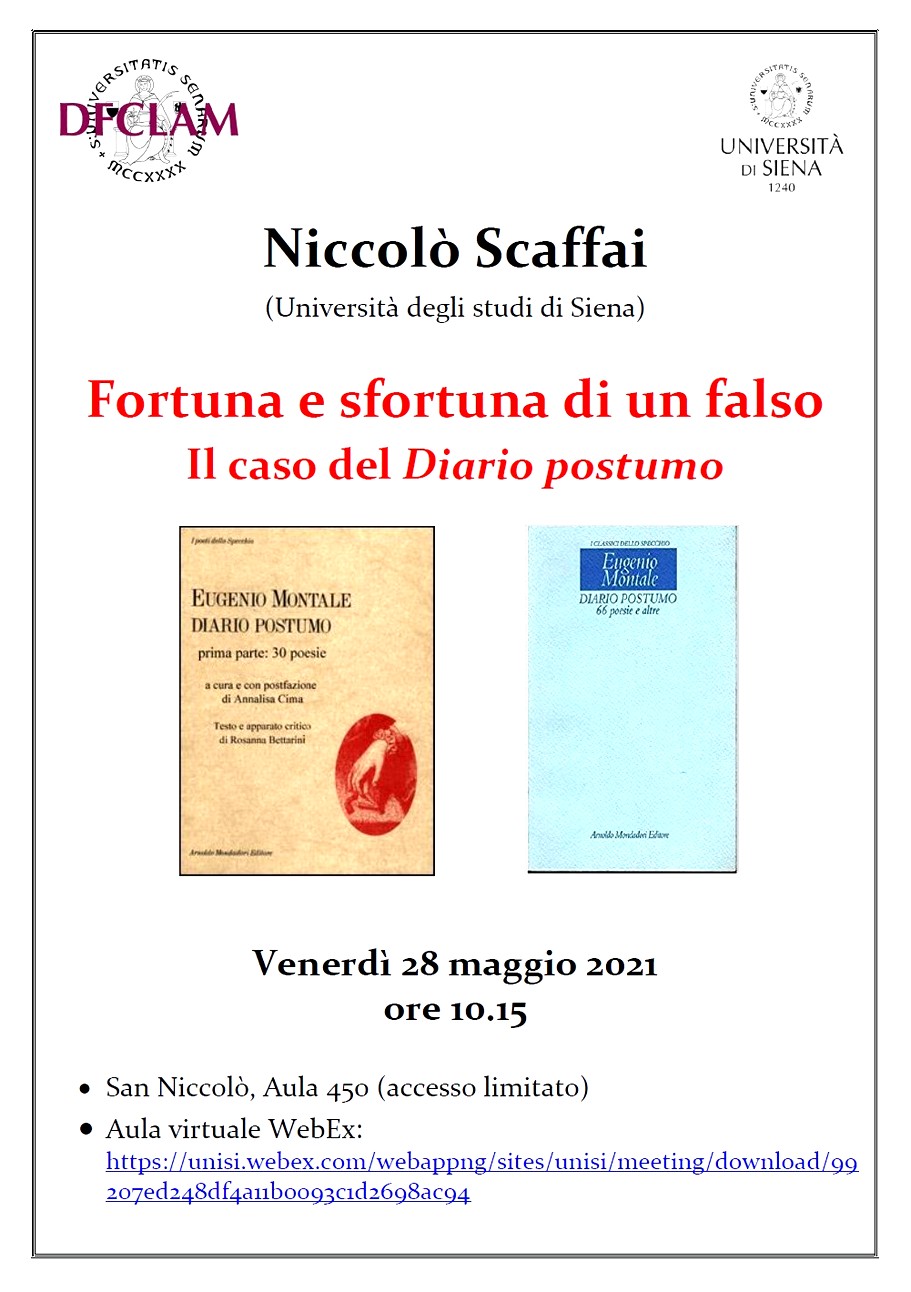
twentytwenty extended conference: domani, l’ultimo incontro, con niccolò scaffai

Domani, 25 maggio, ore 18, ultima sessione degli incontri del convegno TwentyTwenty Extended Conference, organizzato da polisemie.it:

Niccolò Scaffai
(Università degli Studi di Siena):
Poesia e ecologia: prospettive contemporanee

*

Tutti gli incontri si tengono sulla piattaforma Microsoft Teams, a cui è possibile accedere tramite questo link. Il link è disponibile anche sulla pagina web del convegno. Si può scaricare gratuitamente l’app Teams sul computer, oppure accedere tramite browser (Google Chrome).

È possibile consultare il programma e la descrizione dettagliata del progetto alla pagina del convegno.

*

incontri a cura di
Giulia Bassi e Stefano Milonia

_

video della 12ma sessione di twentytwenty extended conference: con paolo zublena, costantino turchi, alessandro minnucci

Chair: Massimiliano Manganelli

Paolo Zublena (Università di Genova), Due o tre cose che so (e non sapevo) sulla poesia di ricerca

Costantino Turchi (Università di Roma Sapienza), L’immagine nello spazio della poesia

Poster: Alessandro Ludovico Minnucci (University of Chicago), La poesia performativa contemporanea in Italia: per una nuova metodologia di ricerca

_

of course the asemic is absurd / jim leftwich. 2021

If I am writing about the word “asemic”, I am thinking about patience and persistence. I am thinking about failure as a source of energy, as that which keeps an absurdist idea of enlightenment alive and almost thriving. Standing in the absurd center of the asemic universe, we are surrounded by unexamined exits and entrances, unexplored starting-points, multiple escape-routes leading out in all directions. 
We need to synchronize our watches, then throw them all away. We need to get on the same page of the same map-book, then throw all the maps away. We need to set our compasses, and throw them away. We must promise each other to get together, at some unspecified time and place, later in our lives, to define our terms and make public our consensus definitions. Until then, we have some exploring to do, some making and some thinking, some reading and some writing.
Tim Gaze wrote, in an email responding to my recent texts (05.21.2021), that “asemic is an absolute state, whereas desemantizing is a process or matter of degree”.
He also wrote in the same email that he “consciously let go of asemic writing several years back”.
On January 27, 1998, I wrote to Tim, saying “the asemic text would seem to be an ideal, an impossibility, but possibly worth pursuing for just that reason.”
Desemantized writing is not an ideal, is not an impossibility. It is a very specific kind of writing, produced for very specific reasons. To desemantize writing is to intentionally make it less readable, less capable of participating in the language-game of giving information. 
We might aspire to the absolute state of asemic writing, producing beautiful and/or provocative failures in our quest, but we achieve desematized writing, to one degree or another, whenever we choose to do so.
In response to my recent texts, John M. Bennett wrote (05.20.2021) “i like ‘desemanticized’ better than ‘asemic’ myself; the latter term was always a bit misleading, even downright wrong sometimes, I thought; except perhaps in a few situations…”
In the late 1990s, “asemic” was not the word I wanted or needed, but it was the best I had at the time. For the past 20 years or so I have been exploring alternatives to the word “asemic”. For now, and for my purposes (which are not necessarily the same purposes as those of some likely readers of this text), “desemantized” (or “desemanticized”) is an improvement, a step in the right direction. It is a provisional solution to a problem.
These days, the term “asemic writing” is very widely used, and is surely in no danger of being discarded or replaced. My thoughts about the term “desemantized writing” will circulate, if at all, within the context of the global asemic writing community. As I write this, in the late spring of 2021, the theory and practice of asemic writing are not in any sense dead, the possibilities have not been exhausted. The Sisyphean struggle to attain the absolute state of asemic writing, absurd though it may be, continues to yield moments of existential fulfillment, and perhaps every now and then even a kind of happiness. 
My hope for my recent writings is that they might invigorate an increasingly faceted vision of the world of all things asemic.

jim leftwich, may 2021

ai canali ! ai canali !

iscrivetevi ai canali, carissim*:

mg (tipo Rai1):
https://www.youtube.com/channel/UCUN9mDuP3m6UsVdj50Kgo4Q

slowforward (una specie di Rai2):
https://www.youtube.com/channel/UCF4pbAEEAcjwznYErB-SUvg

differx (sicuramente una roba simile a Rai3):
https://www.youtube.com/user/differx

(n.b.: ogni riferimento a tv ed entità realmente esistenti ma soprattutto esistite è puramente casuale o frutto di giuoco)

keep moving / jim leftwich. 2021

I was a poet, and for me that meant pushing the edges of poetry, and the edges of myself while writing poetry. The line was an edge, and the rhyme was an edge, and the stanza was an edge, and the syllable was an edge. Eventually it became impossible to ignore the idea of the letter as an edge. Once having agreed to that, it became impossible to ignore the shapes of the letter — first the shapes of the printed letters, in an array of fonts, and then the shapes of the handwritten letters.

From the outset, the idea of producing meanings had been for me subordinate to the idea of making poems. If all I had wanted to do was produce meanings, I would have written conventional sentences and paragraphs. But that was not what I wanted.

So I wrote poems, and I pushed the edges of the poem, and in doing that I was pushing the edges of myself, my sense of satisfaction and achievement, my sense of my own skills and competence, and I was never satisfied, intentionally, by choice, never satisfied, I refused to accept the sense of being satisfied, so eventually, inevitably, I found myself producing desemantized or asemic writings.

And that was a plateau, a stage, and I knew from the outset that I was only passing through, that I would never be satisfied with desemantized or asemic writing, any more than I had been satisfied with writing conventional poems.

Over the years a community of asemic writers has become active and visible and, to the extent that I am a part of it at all, my role has evolved to be a kind of advocate for incessant criticality. As a participant in the conversation around asemic writing, I can be counted on to say something similar to “yes, you are right, but…” Yes, you are right, but that is not enough, it is not even particularly important. What is important is to keep moving. Asemic writing works for you? Fantastic. Now move on and do something else.

Jim Leftwich