https://publicdomainreview.org/essay/the-early-modern-camera-obscura/
Archivi categoria: links
“palestina, l’isola che non c’è” – editoriale di alberto negri sul ‘manifesto’
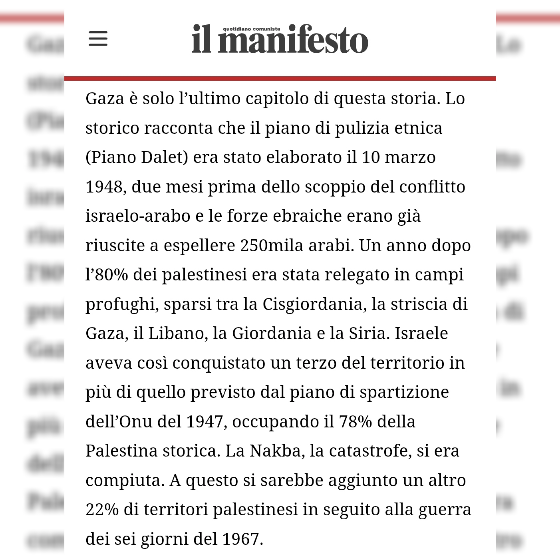
https://ilmanifesto.it/palestina-lisola-che-non-ce
#Gaza #genocide #genocidio #Palestine #Palestina #warcrimes #sionismo #zionism #starvingpeople #starvingcivilians #iof #idf #colonialism #sionisti #izrahell #israelterroriststate #invasion #israelcriminalstate #israelestatocriminale #children #bambini #massacri #deportazione #concentramento
alcuni post recenti su slowforward.net 9 febbraio – 9 marzo 2025 (sped. 26 e 27 marzo 2025)
alcuni post recenti su slowforward.net 8 gennaio – 8 febbraio 2025 (24 marzo 2025)
si ripropone qui la newsletter di slowforward con i post dell’ultimo periodo (la differenziazione tra i caratteri non è voluta)
>>> per leggere, cliccare sui titoli
post, link e reindirizzamenti recenti, per la palestina
nel caso i miei post precedenti qui su effebì patissero di qualche bizzarro e certo non intenzionale ○scur4ment○, ecco:
https://mastodon.uno/@differx/113852713404977734
https://mastodon.uno/@differx/113852893580629429
https://mastodon.uno/@differx/113852642380103847
https://mastodon.uno/@differx/113852456100776321
https://mastodon.uno/@differx/113852363660235109
https://mastodon.uno/@differx/113846431080805958
https://mastodon.uno/@differx/113846381703361255
https://mastodon.uno/@differx/113835730110577679
https://mastodon.uno/@differx/113835717907967457
https://mastodon.uno/@differx/113833279864590426
Il canale telegram di slowforward
=
#scritturadiricerca
#scritturediricerca
#experimentalwriting
#glitch
#noise
#vispo
#installance
#materialiverbovisivi
#asemicwriting
#improvisedmusic
#palestine
#palestina
#antifascism
#antifascismo
#antifa

syxty umbrella
La finestra di Antonio Syxty, L’intervallo dedicato alla poesia, i podcast, il blog Rooms For Secrets & altro continueranno anche nel 2024 sotto lo stesso ombrello:
https://www.mtmteatro.it/progetti/syxty-umbrella/

mg @ threads &tc. [see you here and around]
 a prescindere da slowforward, e insieme a slowforward, chi volesse può seguire gli altri materiali e le notizie (politiche, anche) su Threads: https://www.threads.net/@marco.giovenale (dove, pure, inserisco e inserirò riferimenti e link a slow, ma anche molto altro).
sembra, al momento, un ambiente meno arido e ‘colonizzato’ di Twitter, e meno povero, caotico e litigioso di Facebook. oltretutto, permette di caricare brevi audio, dunque funziona anche come micro-podcasting.
con una certa cautela, mi sentirei per il momento di suggerirlo.
tra l’altro è legato a Instagram, quindi a un social network meno obsoleto degli altri due appena nominati.
le mie linee di interesse su Threads – come qui su slowforward – sono e restano le scritture eslege, quindi la ricerca e la sperimentazione in letteratura, la prosa in prosa, la testualità ‘disturbata’, il plurilinguismo, e poi la critica letteraria, la cultura della complessità, la politica, la Palestina, la fotografia, il disegno, la teoria estetica, le traduzioni, l’arte contemporanea (-issima), il glitch, la musica d’improvvisazione e sperimentale, il teatro di ricerca, le avanguardie storiche e quelle attuali, la poesia concreta, l’asemic writing, il flarf, il googlism, gli sviluppi di Fluxus, l’arte e le operazioni concettuali passate e presenti, la videoarte, gli scritti di poetica, e in assoluto – insisto – la scrittura non assertiva. (anche la scrittura assertiva, se fatta bene). (mai quella asservita).
e comunque, per un riepilogo:
slowforward
slow whatsapp
slow telegram
slow tumblr
+
marco / instagram
marco / threads
marco / twitter
+
differx / tumblr
differx / instagram
differx / bluesky
see you around
‘koko’ – next generation journal, issue #1, “text/image parergon”
KOKO – Next Generation Journal
Text/Image Parergon
Here is the first thematic “space” of KOKO – The Next Generation Journal, a Shared Campus publication.
Text/Image Parergon explores potentials and challenges in the relations of scriptorial and pictorial signs. How do text and image respectively frame an artefact? Does the combination of both constitute an extended value or merely a supplementary by-product that primarily appeals to the visual and other senses? Should such parerga be considered positively as added experiential benefit, or negatively as distractive embellishments of a core? Questions like these are explored in an initial set of academic “Conversations”, through the “Proceedings” of a dedicated conference and in image-with-text “Essays” by researchers working on and across the boundaries of scholarly research and creative production.
Visit Text/Image Parergon

Conversations
- Johanna Drucker – Para Meta Dia
- Bhanu Kapil – A Talk about Ban en Banlieu
- David Finkelstein – Movable Types – Poetry as an Effect of Printing Trade in the Victorian Age
- Michael Whittle – Portraits of Thought
Proceedings: Distancing – Contemporary Art in Reciprocity with Philosophy
Hosted on 16 May 2019 at the Kunstraum Kreuzlingen (CH) by the Zürich University of the Arts the symposium was set to explore the iconography of philosophical texts – in particular the imagery of Lady Philosophy as first introduced into philosophical tradition by the late antique writer Boethius (477–524) in his work The Consolation of Philosophy (approx. 524). The juxtaposition of medieval thinking, its articulation in illuminations, and in return their impact as challenge for contemporary creative practices, highlighted the need to investigate the mostly unquestioned principal opposition between immaterial thoughts and materialized images.
- Barbara Ellmerer – Leaving the Cell
- Daniel Irrgang & Clemens Jahn – Chronotopologies
- Vera Kaspar – Dialogues – Gazes, Gestures and Tools
- Dominique Neuwirth – Desktop
- Catarina Zimmermann-Homeyer – Experimental Woodcuts as Strategies of Communication
Essays
- Leila Peacock – Diagrammarians
- We are Publication – The September Garden: Plots
- Nils Röller – Interfacing Philosophy
Space Editors: Peter Benz & Nils Röller

KOKO Editorial Statement
It is the ambition of KOKO to establish a lively and continuously evolving community of researchers contributing to respective topics; we therefore are always interested to receive feedback and/or potentially new contributions also to already existing “spaces”.
Where the more conventional formats have exhausted their possibilities, artists, designers and/or other creatives may use KOKO to create a metaphorical space for exchange through an externalised conversation between the researcher/creative practitioner and her subject.
www.koko-journal.net
www.shared-campus.com
29 giugno: due compleanni

29 giugno:
buon compleanno Giacomo (29 giugno 1798),
buon compleanno GAMMM (29 giugno 2006)
.

Scopo della “vera contemporanea poesia”, annotò Leopardi nel 1829, è di accrescere la vitalità; e, dopo questa osservazione disarmante, aggiungeva che a quei tempi raramente la poesia era capace di tanto.
(Alfredo Giuliani)
_
prossimità a / affinità con il concetto di “installance”: un esempio
sull’editoria, soprattutto di poesia: 4 post + 1 e spiccioli
negli ultimi tempi ho cercato di chiarire perché in editoria e sul piano distributivo, e di conseguenza in poesia, le cose vanno in un certo modo.
ho detto la mia in quattro post, in particolare. questi:
https://slowforward.net/2022/02/21/poesia-per-il-pubblico-a-k/
https://slowforward.net/2022/10/12/italia-sommersa-francia-emersa/
https://slowforward.net/2023/04/23/il-ritorno-allordine-editoriale-distributivo-differx-2023/
https://slowforward.net/2020/07/14/responsabilita-in-editoria/
e per sorridere:
https://slowforward.net/2020/09/12/i-potenti-tribolati-differx-2020/
